Off-Grid Solar Systems in Hyderabad — Complete Energy Independence
Off Grid System
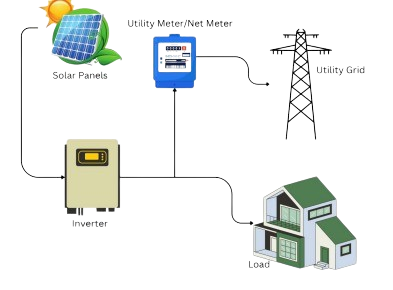
An off-grid solar system is an independent solar power solution, providing and storing electricity without reliance on the traditional electricity grid. Solar panels generate electricity during the day, and batteries store excess energy for use when the sun isn’t shining. The solar inverter then converts the stored or generated DC electricity to usable AC power for household, commercial, agricultural or other electrical loads.
For Hyderabad properties which are not connected to grid electricity, or where the power supply is unreliable or not easily accessible, an off-grid solar system can be a practical and independent way to generate electricity. They are particularly useful for remote homes, farmhouses, agricultural properties, rural facilities, telecom or monitoring sites and locations where extending a grid connection may be costly or impractical.
Samraj Solar designs and installs off grid solar systems in Hyderabad, Telangana and Andhra Pradesh as per the property’s electricity needs, available solar resource, backup duration, location, load profile and budget. The system is sized to the actual appliances and equipment that need to run, not a standard package for each customer.
The primary components are solar PV panels, solar batteries, an inverter and a charge controller, in addition to mounting structures, DC and AC cables, protection equipment, earthing and other necessary electrical safety components.
Solar panels determine how much energy can be generated during the day. Battery bank size – This refers to the amount of energy that can be stored for use after sunset or during periods of low solar generation. The inverter determines the amount of electrical load the system can handle including the starting or surge requirements of equipment like refrigerators, pumps, motors and air conditioners. A charge controller manages charging the battery from the solar array and in systems utilising MPPT technology, aids in extracting available solar energy efficiently under changing operating conditions.
Battery technology is a key factor to consider for Solar Battery Backup in Hyderabad. Lithium-ion batteries, including lithium iron phosphate (LiFePO4) batteries, are increasingly used for solar storage due to their high usable capacity, compact design, reduced routine maintenance requirements and ability to support frequent charge-discharge cycles. They are more expensive upfront but can be beneficial for applications that need to be cycled daily.
VRLA Batteries VRLA batteries are an alternative option for off-grid solar systems and have been traditionally used in backup-power applications. They may have a lower initial purchase cost, although they are generally heavier, and may have lower usable capacity and cycle life compared with modern lithium battery systems depending on the application and operating conditions.
Also, the climate of Hyderabad makes conditions for battery installation important. Batteries must be installed with adequate ventilation and temperature control if necessary, in accordance with the manufacturer’s instructions. Battery selection and installation should take into account the local operating environment rather than the initial purchase price. Too much heat can affect the performance and service life of the battery.
The correct size of an off-grid solar system in Hyderabad depends primarily on the electricity consumption and the amount of backup required. A system designed to power only lights, fans, Wi-Fi equipment and a refrigerator will have very different requirements than a system expected to run air conditioners, water pumps, motors or other high power equipment.
The size of solar panels and battery storage required depends on daily energy use, backup time, depth of discharge and inverter losses. Properties used during the day may require less battery storage, while homes and farms that need power at nite or for irrigation pumps may need bigger systems. Therefore, the cost of an off-grid solar system in Hyderabad depends on the solar capacity, battery technology, inverter rating and backup requirements.
PM-KUSUM Component B supports eligible standalone solar agricultural pumps in off-grid areas for agricultural customers, subject to applicable state-level requirements.
An off-grid system can power essential loads like lights, fans, refrigerators and water pumps without depending on the conventional grid. It is different from a normal inverter, that it uses solar panels as its main energy source and uses batteries to save electricity for future use.
Samraj Solar offers off grid solar solutions in Hyderabad, Telangana and Andhra Pradesh, customised around each property’s electricity consumption, load requirements and backup needs.
Benefits
- An off-grid solar system generates and stores its own electricity, so the property can function without a traditional utility connection for standard power requirements.
- Off-grid solar can supply electricity to remote farms, farmhouses, rural properties and other places where extending or maintaining a grid connection may be difficult.
- Batteries store electricity produced during the day and provide it after sunset or when solar production is temporarily inadequate.
- An appropriately configured off-grid solar system, because it is designed to function separately from the grid, can still provide power to connected loads when utility power fails.
- For appropriate applications, solar and battery storage can reduce the need to run diesel generators for day-to-day electricity requirements, which can reduce fuel consumption, noise and maintenance requirements.
- Instead of selecting a standard system size, the solar array, inverter and battery capacity can be designed based on the property’s actual electricity consumption.
- Off-grid solar can meet the electricity needs of agriculture including eligible standalone solar pumping applications under relevant government schemes like PM-KUSUM.
- Customers can compare lithium-ion and VRLA battery technologies against budget, available space, expected cycling, backup requirements and long-term operating conditions.
- Sites far from existing electricity infrastructure can utilise solar generation and storage without waiting for traditional grid expansion.
- Solar panels can generate electricity from sunlight for many years, helping the property establish a renewable energy source.
- Off grid systems can be tailored for residential properties, farmhouses, farms, rural businesses, remote infrastructure and other sites with appropriate solar resources.
The biggest advantage to an off-grid system is that you combine solar generation with energy storage to provide an independent power solution. But the system should be properly sized to meet the property’s electricity needs. Having a larger solar array alone does not guarantee energy independence if the battery bank or inverter are not large enough for the loads needed.