Solar Panel Maintenance Is Not Optional. It Is What Protects the Return.
A solar system is not a “install once and forget” system. That’s lazy thinking. While the panels may sit quietly on a roof or ground mount, the system is still an asset with moving economic parts: output, soiling, inverter health, wiring, monitoring, structure, and weather exposure.
According to the U.S. Department of Energy, “solar arrays require operations and maintenance (O&M) after installation to operate properly, meet energy production goals over the lifecycle, and extend system life.” DOE says regular O&M also helps mitigate risks like soiling, micro-cracking, internal corrosion and other problems.
That is the entire point. Maintenance is not an overhead line to be loathed. It is the mechanism that protects your yield, your warranty and your payback.
That’s reflected in Samraj Solar’s company knowledge base. It claims to undertake complete EPC work including design, procurement, installation, regulatory approvals and long-term O&M and that its systems are designed for strong performance across Telangana and Andhra Pradesh.
Why Solar Maintenance Matters More in South India
South India’s solar systems are up against a heady cocktail of heat, dust, seasonal rains, humidity and, in many places, industrial pollution. That doesn’t mean solar is fragile. This means maintenance is situational.
NREL stresses that natural soiling leads to a reduction in PV energy output and an increase in levelized cost of electricity as material deposits on PV surfaces reduce the throughput of light and thus energy production. NREL also points out that soiling losses can become a serious economic problem and that cleaning or mitigation strategies are important for long-term yield.
For Telangana and Andhra Pradesh, the practical implication is easy:
- dry periods build dust faster,
- monsoon can help clean modules naturally,
- industrial corridors create more soiling pressure,
- and coastal or humid environments increase corrosion attention.
Modern panels can still generate about 10% to 40% of peak capacity on cloudy monsoon days using diffused light, according to Samraj Solar’s knowledge base, and heavy rains can naturally wash away dust and soiling that would otherwise reduce efficiency by 15% to 35% in dry months.
So maintenance in TS/AP is not an obsession. It is about leaving money on the table
What Is Solar Panel Maintenance?
Solar Panel Maintenance is the ongoing work to ensure your system continues to generate power efficiently and safely over time. This includes cleaning, inspection, monitoring, electrical testing, inverter review, shading management, corrosion mitigation and corrective repair as required.
DOE’s O&M resources note that a complete PV maintenance plan should contain contact information for responsible parties, system documentation and the operational structure required for proper system management. DOE also said standard best practices once the array is in operation include regular inspections, cleaning and maintenance.
- For a homeowner, that means the system needs basic care.
- For a commercial property, it means the system needs a schedule.
- For an industrial site, it means the system needs a program.
What Are the Main Things That Reduce Solar Performance?
There are five main performance killers:
- Soiling and dust
- Shading
- Loose or damaged electrical connections
- Inverter problems
- Corrosion or structural degradation
O&M minimises the risks of soiling, micro-cracking and internal corrosion, DOE says. Both NREL and DOE identify cleaning and monitoring as key to maintaining output.
The point is not that all systems will fail if you ignore them. “The thing is performance erodes quietly when maintenance is bad. This is how owners are surprised by lower generation without knowing why.
Why Cleaning Matters, But Not the Way Most People Think
Many solar owners are over-cleaning or under-cleaning. Neither is correct.
Soiling cuts energy output and increases maintenance costs, NREL says. Cleaning should be optimised against the cost and benefit of improved performance, DOE says. Previous DOE guidance has indicated that cleaning is highly dependent upon local sources of dirt such as diesel soot, dust, construction, agriculture, and industrial pollution.
That means there is no magic, one-size-fits-all cleaning schedule. A roof in the suburbs, where the climate is mild, is not the same thing as a factory shed in a dusty industrial belt.
Table 1: Cleaning Frequency Logic by Site Type
| Site Type | Dirt Risk | Practical Cleaning Approach |
| Residential rooftop in a relatively clean neighborhood | Moderate | Periodic visual inspection and cleaning when visible soiling appears |
| Home near a busy road or construction | Higher | More frequent checks during dry months |
| Commercial office building | Moderate | Scheduled cleaning plus monitoring-based intervention |
| Factory / industrial shed | High | More frequent cleaning and tighter monitoring |
| Ground-mounted site near open land | Moderate to high | Seasonal cleaning plan and dust-response checks |
| Coastal or humid site | Moderate | Cleaning plus corrosion awareness |
Source basis: DOE and NREL both note that soiling is site-specific, and cleaning schedules should be optimised based on local dirt conditions and observed performance, not guesswork.
How Often Should Panels Be Cleaned?
The right answer is: As often as the site needs, not as often as superstition says.
DOE guidance on solar O&M notes that many systems depend on rain to keep the array clean, but cleaning can improve output and should be optimised against cost and performance. The DOE’s maintenance examples include monthly and semiannual tasks such as inspecting modules for damage, removing debris and checking inverter settings.
A practical rule:
- clean when visible dust accumulation starts affecting output,
- clean more often in dry and dusty periods,
- clean less often where rainfall keeps the array naturally cleaner,
- and always check generation data before assuming the panels are dirty.
The owner should not clean blindly. They should clean because the inspection or data says it’s worth doing.
What Should Be on a Solar Maintenance Checklist?
A usable checklist should cover the whole system, not just the glass.
DOE’s O&M resources and best-practice guides highlight documentation, performance monitoring, inspections, and corrective maintenance. The maintenance plan should include: inspection of modules, shading review, inspection of the mounting system, checks of the inverter/charge controller, checks of the batteries where relevant, and removal of debris.
Table 2: Solar Maintenance Checklist by Component
| Component | What to Check | Why It Matters |
| Modules | Cracks, dirt, bird droppings, hot spots, discoloration | Protect output and identify damage early |
| Mounting structure | Loose fasteners, corrosion, tilt integrity | Prevent mechanical failure |
| Wiring and connectors | Damage, loose joints, insulation wear | Reduce fire and performance risk |
| Inverter | Error codes, settings, performance logs | Inverter failure stops generation |
| Monitoring system | Data gaps, communication errors | Catch underperformance quickly |
| Roof area / site | Debris, shading changes, drainage issues | Keep the array productive and safe |
| Battery bank, if installed | Connections, enclosure condition, state of charge behavior | Maintain backup reliability |
Source basis: DOE’s O&M and maintenance guides identify these as core items in a photovoltaic maintenance plan.
Why Monitoring Is as Important as Cleaning
A clean panel that is underperforming is throwing away money , if no one notices .
DOE’s solar performance guidance recognises that consistent monitoring of PV performance can be difficult, especially when communication networks are down or when there are multiple sites involved. It is a real problem for commercial and industrial users. Without monitoring data being checked, owners may not be aware of an output problem until the bill or production report looks wrong.
Monitoring lets you catch:
- inverter faults,
- string failures,
- shading changes,
- communication errors,
- and gradual output loss.
The system should be watched as a financial asset, not only as a technical object.
Why Inverter Maintenance Deserves More Attention Than It Gets
The inverter is the part many owners don’t think about until it breaks down. That’s expensive.
DOE maintenance guidance includes checking inverter settings and for systems with storage, checking the battery enclosure and terminals. If there is a fault in the inverter the system can be shut down or production quickly reduced . The inverter converts the DC output to usable AC power .
Practical inverter checks
- error codes,
- heat or abnormal noise,
- communication failures,
- reduced output,
- and alarms or tripping patterns.
Even if the panels are perfect, if the inverter is not healthy the system will underperform. So maintenance must cover the entire electrical chain.
How Corrosion Quietly Destroys Solar Performance
Corrosion is a slow death. It often starts with fasteners, frames and exposed connectors before it becomes a bigger structural problem.
The DOE’s corrosion guidance points out that poor finishes can result in significant degradation and increased long-term maintenance costs. It also says fasteners are particularly vulnerable. Specifically, the guidance discusses mitigation of risks from galvanic and other corrosion, including cleaning with salt-neutralizing soaps in some cases.
That is especially relevant for:
- coastal areas,
- humid sites,
- industrial zones with harsh air,
- and ground-mounted plants exposed to weather for years.
Samraj Solar’s ground-mounted solutions use cyclone-resistant and corrosion-proof structures, which directly addresses this problem, according to the company’s knowledge base.
Why Soiling and Dust Are a Bigger Problem Than Owners Admit
Soiling is more than “a little dirt.” It’s a production loss that can be measured.
Natural soiling reduces PV energy output and increases levelized cost of electricity, according to NREL, as contamination reduces light transmittance to the cell surface. NREL also notes that soiling can result in significant economic losses and that cleaning schedules should be based on actual site conditions.
Table 3: What Soiling Usually Means in Real Life
| Condition | Likely Effect |
| Light dust | Small but real output drop |
| Long dry period | Soiling accumulates faster |
| Industrial soot | More aggressive performance loss |
| Bird droppings | Localized shade and hot spots |
| Rain after dry spell | Temporary natural cleaning |
| Ignored buildup | Lower output and longer payback |
The message is blunt: dust is not a cosmetic issue. It is a revenue issue.
What Maintenance Looks Like for Residential Systems
Residential maintenance is simpler than commercial or industrial maintenance, but it still matters.
For a home system, the owner should:
- check output monthly,
- look for visible dirt or bird droppings,
- inspect the inverter display or app,
- make sure no new shade has appeared,
- and arrange safe cleaning when output seems to be slipping.
As per Samraj Solar’s knowledge base, the residential systems are built for families in Telangana and Andhra Pradesh who want to break free from high electricity bills and attain energy independence under the PM Surya Ghar support. The company’s residential systems in Hyderabad are also working well and have resulted in immediate bill reduction, it adds.
The obvious point still needs to be made: if the homeowner ignores the system for years, the savings will creep down.
What Maintenance Looks Like for Commercial and Industrial Systems
Commercial and industrial systems are more demanding as the cost of downtime is high and roof exposure is often extreme.
DOE and NREL guidance advocate for a structured O&M program that includes regular inspection, cleaning, monitoring, and corrective maintenance. Documented points of contact, site records and maintenance logs also benefit commercial systems.
Samraj Solar’s knowledge base says commercial and industrial clients in corridors like Hyderabad, Patancheru and Guntur are experiencing HT tariff spikes, heavy load management and CAPEX/RESCO decisions. So maintenance is not an afterthought. It’s part of the maintenance on a bigger asset.
For commercial and industrial sites, the maintenance program should include:
- scheduled cleaning,
- monthly performance review,
- inverter health checks,
- string-level underperformance review where available,
- structural fastener checks,
- and roof drainage and debris control.
Why Rain Helps, But Does Not Eliminate Maintenance
Rain is good. That doesn’t solve everything.
Heavy rains naturally wash away dust and soiling and panels can still generate on cloudy monsoon days using diffused light, according to Samraj Solar’s knowledge base. That is true and useful. But it is not a replacement for a maintenance plan.
DOE guidance also notes that in many systems rain keeps arrays clean, but many situations benefit from cleaning to improve output.
So the right attitude is neither to fear monsoon nor to depend upon monsoon. The aim is to develop a cleaning and monitoring routine that makes sense in both the dry and wet seasons.
What Are the Warning Signs That a Solar System Needs Attention?
There are a few obvious red flags:
- lower-than-expected generation,
- repeated inverter alarms,
- visible dirt buildup,
- bird nesting or debris under panels,
- loose connectors or exposed wiring,
- corrosion on mounting hardware,
- water pooling or drainage issues,
- and sudden performance drops after weather events.
DOE says regular O&M is needed to meet production targets and extend life, and it specifically cites soiling, micro-cracking and internal corrosion as risks good maintenance mitigates.
If the system owner ignores those signs, the system may be running but silently with degraded economics. That’s the actual failure mode.
How to Build a Maintenance Routine That Actually Works
The routine should be simple enough to follow and disciplined enough to matter.
A workable structure:
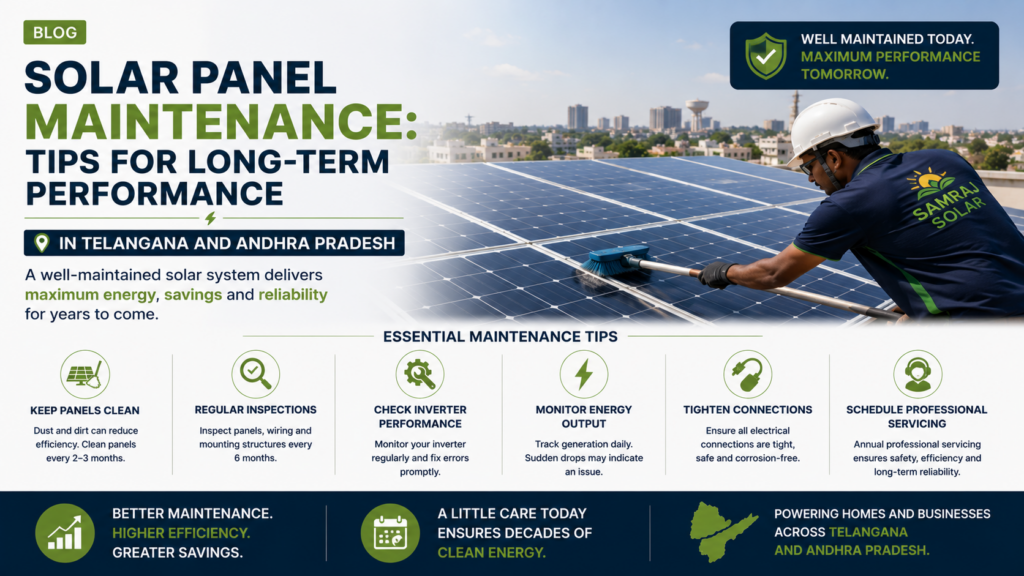
- Weekly or biweekly visual checks for obvious dirt or damage on larger sites
- Monthly monitoring review for performance anomalies
- Quarterly or seasonal cleaning based on site conditions
- Semiannual electrical and structural checks
- Annual deeper inspection for wiring, inverter behavior, and fasteners
Examples of maintenance tasks performed by DOE include monthly and semiannual tasks such as inspection of modules for damage, removal of debris around the array, checking inverter settings and battery maintenance where applicable.
The exact schedule should be adjusted to the site. A dusty industrial roof in Patancheru is not the same as a lightly loaded suburban rooftop in a cleaner neighborhood.
Why Maintenance Protects ROI
The simple answer is: less output, slower payback.
Samraj Solar’s knowledge base says commercial systems can provide fast ROI, often in 2 years, and reduce bills by as much as 80%. Those numbers only hold if the system works well over time.
Maintenance protects ROI by:
- keeping energy output closer to design values,
- reducing avoidable downtime,
- extending equipment life,
- and preventing minor issues from turning into major replacements.
That is why maintenance is not a nice-to-have. It is part of the original investment thesis.
Conclusion: The Best Solar System Is the One You Maintain
It’s not glamorous, but solar panel maintenance is the difference between a system that is earning its keep and one that just sits there.
The evidence is clear:
- DOE: PV arrays need ongoing O&M to meet energy targets, extend life.
- NREL says that soiling lowers the amount of electricity produced and makes electricity more expensive.
- DOE says a good maintenance plan focuses on cleaning, inspections, monitoring and corrosion control.
- Samraj Solar’s own knowledge base is aligned with that reality, including long-term O&M in its EPC service model across Telangana and Andhra Pradesh.
If the system is clean, monitored and maintained it keeps on producing.
If not, the owner pays slowly for the neglect.
This is the whole argument.
FAQs
1) How often should solar panels be cleaned?
There is no one-size-fits-all cleaning interval. The frequency of the right frequency depends on the level of dust, rainfall, nearby construction, road pollution, agricultural activity, bird soiling and whether the site is residential, commercial or industrial. “Many systems rely partially on rain,” the DOE guidance says, “but cleaning should be optimised with the cost and benefit of improved performance.” In a dusty environment it may need to be cleaned more often. In a cleaner environment with regular rain, less frequent cleaning may be adequate. “Guessing isn’t the best way. It is to observe generation data and visually inspect the array. If you can see the dirt, and the printer is losing its grip, then it’s time to clean it. Hence maintenance remains economical and does not become excessive.
2) Does rain clean solar panels enough?
Rain helps, but it won’t solve all soiling problems. Heavy rains can naturally wash away dust and soiling and panels can still generate using diffused light during monsoon, notes Samraj Solar’s knowledge base. But rain won’t clean up all the contaminants and it won’t fix corrosion, inverter problems, bad wiring or shading issues. In other words, rain is helpful, but incomplete. But manual cleaning and monitoring are still required where there is sticky dust, industrial soot, bird droppings or long dry spells between rains. The question is not whether rain helps. It does. The question is whether rain alone maintains the system at its designed yield. It does not usually.
3) What are the most important things to inspect on a solar system?
The most important are modules, mounting hardware, wiring, inverter behaviour, monitoring data and site conditions around the array. DOE maintenance guidelines consist of module inspection and debris removal, inverter checks, battery checks (if applicable), and documentation of the system overall. The risk of corrosion on the fasteners and frames is also important, especially in humid or coastal areas. In practice, an inspection should determine whether the array is dirty, shaded, damaged, loose, miswired, or not reporting data correctly. A solar system can be underperforming because of one bad string, one inverter problem or one corroded component, but look fine from afar. Inspection is what keeps that slow failure from being expensive.
4) Why does dust reduce solar output?
Dust blocks the light that reaches the photovoltaic cells, lowering solar output. NREL says contamination on PV glass reduces light transmittance and thus reduces power production. This means even a thin layer of dirt can have a measurable effect especially if it accumulates across many panels or remains on the array for a long period of time. The problem is exacerbated by the presence of dust mixed with soot, moisture or bird droppings. In dry dusty areas or industrial environments the losses can be high enough to affect payback and operating cost. Soiling is therefore not classified as a cosmetic problem in technical solar operation. This is a performance issue. The cleaner the panels, the closer the system stays to its designed output.
5) What is the biggest maintenance mistake solar owners make?
The biggest mistake is to ignore performance data and wait for a visible failure. Many owners believe that if the panels are still on the roof, all is well. That’s not how solar systems fail. They often fail slowly. Dirt builds up. Output decreases. Monitoring data is ignored. A connector loosens. An inverter starts to trip. Corrosion develops slowly. The owner doesn’t even know, but the system has been losing money for months. DOE’s O&M guidance makes clear that regular inspections, cleaning and monitoring are part of preserving system life and output. A smart owner looks at the numbers, not just the roof. If the generation is wrong, then the problem needs to be addressed before it gets worse.
6) Does solar maintenance differ for homes, offices, and factories?
Yes, a whole lot. A home is generally going to require a lighter maintenance: occasional cleaning, output checks and basic inverter monitoring. The bill and downtime cost are affected more, so an office or commercial property needs a more structured maintenance schedule. The most disciplined approach is required in a factory or industrial shed as dust, soot, roof heat and operational stakes are higher. Both DOE and NREL note that issues of soiling, corrosion, and monitoring are site- and environment-dependent. So, the maintenance plan should be in accordance with the asset type. A factory near heavy traffic or industrial activity might need cleaning more frequently than a suburban house. A larger site may also benefit from a documented O&M process rather than informal checks. System type is the same. But the maintenance intensity isn’t.
7) Why is inverter maintenance so important?
This is because the inverter is where the solar array turns into usable electricity. If the inverter is not working or not working properly, the panels still get sunlight but the system will not generate the expected AC output. The DOE maintenance guidance includes checking inverter settings, monitoring performance and doing corrective maintenance if needed. For systems with battery storage, the inverter and battery enclosure become even more important as that’s what backup continuity relies on. Owners often become obsessed with panel cleaning and ignore inverter alarms. That’s wrong. A dirty panel gives progressively less. A failed inverter can shut a system down completely. Any serious maintenance regime should include inverter checks, especially in commercial or hybrid systems where downtime is expensive.
8) Why should Samraj Solar be considered for solar maintenance and O&M?
Maintenance only works when it is considered part of the asset lifecycle, not an afterthought. According to Samraj Solar’s knowledge base, the company offers complete EPC and long-term O&M services for projects throughout Telangana and Andhra Pradesh, including site assessment and design, installation, approvals and maintenance. It also says the company serves residential, commercial, industrial and institutional customers that need not just installation but reliable performance. That’s important because the value of a solar system is created over time, not at commissioning. A team that understands the local conditions, the industrial load patterns, monsoon behaviour and long term accountability is better placed to keep the system productive. In short, maintenance is NOT an afterthought. It is part of the original compact