
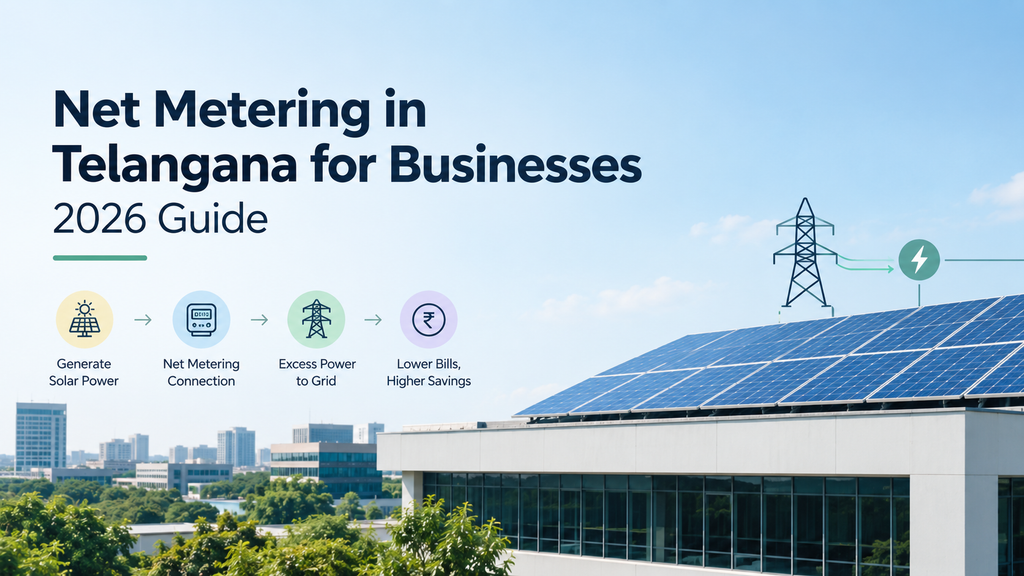
Telangana’s commercial electricity bills rise further. Offices, warehouses, retail outlets, hotels and light industrial units pay commercial tariffs which routinely hover between ₹7 and ₹9 per unit after fixed charges. Many of these loads peak during daylight hours, just when a rooftop solar system produces most of its power. Net metering is the regulatory tool that turns surplus daytime generation into bill credits. To know how it really works in 2026 is the difference between a system that produces predictable savings and one that falls short of expectations.
Quick Answer Box
As per the 2025 TERC regulation, commercial consumers of Telangana can install rooftop solar up to 80% of their sanctioned load, with a maximum limit of 500 kW in aggregate, under the net metering scheme. Application is made online through the portal of the TGSPDCL / TGNPDCL. A bi-directional meter measures both import and export. Solar offsets use a self full retail tariff. Extra units are credited to you and any big surplus is paid at a rate regulated by the government. Once the paperwork is done the process typically takes a few weeks from application to commissioning.
Why Net Metering Matters for Commercial Loads
Most of the commercial activity is during the day. Solar generation therefore displaces the high-cost units first. When generation exceeds instantaneous demand, the surplus is fed into the grid and noted as export. At the end of the billing cycle, the DISCOM nets off the figures. The business only pays for the net units that are imported, or carries forward credits when exports exceed imports. This setup is the heart of how to apply for net metering for business in telangana.
Current Regulatory Framework: TERC Regulation 2025
Telangana Electricity Regulatory Commission (TERC) has superseded the net metering rules of 2016 with the Rooftop Solar PV Grid Interactive Systems Regulation 2025. The new framework defines 4 schemes: net metering, group net metering, gross metering and virtual net metering. For typical commercial rooftop systems, the main route is still net metering up to 500 kW. Gross metering available upto 1MW. Commercial and Industrial consumers are restricted to 80 percent of sanctioned load or contracted demand. Residential and government customers may be allowed up to 100% of sanctioned load.
The project economics for businesses that comply with the rules will improve with the exemption from banking charges, wheeling charges and cross-subsidy surcharges in a number of metering arrangements.
Capacity Limits That Affect Business Decisions
The most common constraint for commercial consumers is the 80% rule. For example, a business with a sanctioned load of 100 kW can install solar up to 80 kW with net metering. Beyond this limit, the project is subjected to gross metering or other arrangements with different value for exports. Even if the consumer’s sanctioned load appears to be sufficient, the transformer capacity at the local distribution point can provide an additional practical limit. The DISCOM’s feasibility study identifies these constraints in advance.
How Net Metering Works in Practice for a Business
The existing meter is replaced by a bidirectional meter. During the day, the solar system will first serve the on-site load. Any surplus is exported and the meter measures the flow out. The business imports from the grid at nite or when generation is low and the meter records import. At the end of the billing period, the DISCOM determines the net position. Self consumed solar is valued at the full retail tariff as those units never show up as import. Exported units are settled according to the relevant settlement rules.
The Committee has referred to a settlement rate of Rs 2.57 per unit for some excess export situations earlier. Businesses should check the exact treatment applicable to their category and DISCOM at the time of application.
Net Metering versus Net Billing
Net metering credits exports unit for unit (or at a regulated rate close to retail in many cases) and nets against import. Net billing typically credits exports at a lower avoided-cost or wholesale-indexed rate, but still allows self-consumption to offset full retail. The prevalent form of commercial arrangement in Telangana is still more akin to the traditional model of net metering, and that is why most of the commercial load during the day time prefer it. Pure net billing would decrease the value of surplus generation and increase payback for systems exporting large quantities.
Disadvantages Businesses Must Weigh
But net metering has its limits. The commercial consumers’ capacity is restricted to 80 percent of sanctioned load. If there is a large excess generation over monthly consumption, it may be settled at a lower regulated rate rather than full retail. Approval can be delayed or limited by feeder or transformer constraints. Pure behind-the-meter systems without export do not have the process step of the bi-directional meter and the associated formalities. The cash-flow value of large seasonal surpluses may depend on whether annual or periodic settlement rules are used. Finally, the system still depends on grid availability, it does not provide backup during outages unless batteries are added.
If the system is sized for the actual day load, not the maximum theoretical roof capacity, these constraints are acceptable.
PM-KUSUM Scheme Relevance for Commercial Businesses
PM-KUSUM is basically a scheme for solarisation of pumps for irrigation and other farmer-centric components. Its core components do not include general commercial businesses, shops, offices and non-agricultural industrial units. “Businesses should not expect support in terms of PM-KUSUM capital or special metering arrangements. They will continue to follow the regular commercial net metering route as per the 2025 TERC regulation and the relevant DISCOM procedures.
Step-by-Step Application Process
The process begins with an online application on the TGSPDCL or TGNPDCL portal as per the location of the premises. The usual documents required are the latest electricity bill, identity proof, ownership/occupancy proof of the property, single line diagram of the proposed system and technical specifications of the modules and inverter. The application fee is Rs 2,500 for LT consumers and Rs 15,000 for HT consumers.
A technical feasibility study is carried out by the DISCOM, looking at issues like transformer capacity, feeder loading and safety. After feasibility confirmation, the consumer gets the approval and has to complete installation within the stipulated period (usually 90 days). The system is installed to the required standards by a registered EPC. The DISCOM then installs the bi-directional meter, checks the installation and gives the final commissioning clearance. Net metering credits start in the following billing cycle.
Businesses searching for net metering for business in telangana online will receive the official commencing points of portals of TGSPDCL (tssouthernpower.com) and TGNPDCL. Please check the exact online forms and document upload requirements on the live portals at the time of application.
Technical and Commercial Realities That Determine Results
System sizing should not be based on roof area, but on real load profiles. If it is oversized relative to the daytime demand, the excess export may be settled at a lower rate. It does nothing to solve the problem of the high daytime tariffs that undersizing leaves. It’s important to structurally assess commercial roofs, as many warehouse and factory roofs need engineering verification for distributed loads and wind uplift. ALMM compliant modules and correctly rated inverters guarantee long term performance and regulatory compliance. CEIG clearance is mandatory for systems above certain limits, usually 100 kW or as specified by the Chief Electrical Inspector.
Generation is lean during monsoon months. Good design considers seasonal variation in an effort to set realistic expectations for annual yield. Post-commissioning performance monitoring enables the business to track the real ratio of self-consumption to export, and adjust operations as necessary.
Table 1: Technical & Financial Snapshot for Commercial Net Metering in Telangana (2026)
| Parameter | Typical Commercial Range | Notes |
| Capacity limit | 80 % of sanctioned load, max 500 kW | TERC 2025 |
| Application fee | Rs 2,500 (LT) / Rs 15,000 (HT) | Payable online or by DD |
| Feasibility timeline | 7–15 working days (typical) | Subject to DISCOM workload |
| Bi-directional meter | Supplied and installed by DISCOM | Cost usually included in process |
| Self-consumed solar value | Full retail tariff | Highest value component |
| Excess export settlement | Regulated rate (e.g. Rs 2.57 referenced) | Confirm current rate at application |
| Indicative payback (CAPEX) | 4–6 years for well-matched systems | Depends on tariff and load match |
The table is a high-level overview. The actual figures for any given business will depend on the precise tariff category, sanctioned load, roof characteristics and local grid conditions. Decisions on investment can only be taken after a feasibility study for the specific site.
Commercial consumers who view net metering as a billing mechanism and not a total energy strategy miss opportunities. By shifting non-critical processes to solar hours, the share of self-consumed units is increased and therefore the effective value of the system. Pure grid-tied systems have the quickest simple payback for most commercial daytime profiles, but combining net metering and modest battery storage can improve resilience and peak-demand management.
The regulatory environment in 2026 is more transparent than in previous years. Capacity limits are spelt out. There are application portals. Settlement rules have been clarified in the Commission procedure. The companies that prepare complete documentation, choose an experienced EPC familiar with the TGSPDCL and TGNPDCL processes and size the system to actual daytime demand always achieve the intended bill reduction.
Table 2: Generic Advice versus Strategic Commercial Approach
| Aspect | Generic Advice Often Heard | Strategic Approach for Commercial Businesses |
| Capacity decision | Install maximum possible on the roof | Size to 80 % of sanctioned load and actual daytime demand |
| Application timing | Apply after installation | Secure feasibility and approval before major capital outlay |
| Export expectation | All surplus will be credited at full retail | Plan for regulated settlement rate on large excess |
| Metering model | Net metering and net billing are the same | Prefer classic net metering for daytime commercial loads |
| PM-KUSUM | Available for all businesses | Restricted to agricultural components |
| Structural check | Roof looks adequate | Independent engineering assessment required |
| Monitoring | Check the bill once a year | Track self-consumption ratio and performance monthly |
| Ownership model | Always CAPEX | Model both CAPEX and RESCO against cash-flow needs |
The strategic column delivers systems that meet regulatory requirements as well as financial objectives. The generic column typically leads to delays, less savings than expected, or redesigns later.
Businesses that do a proper load analysis, get DISCOM feasibility early and choose technology for the climate of Telangana can position themselves to convert rising commercial tariffs into a controllable operating cost for the next two decades.
People Also Ask
What are the disadvantages of net metering?
The 2025 regulation caps capacity at 80 percent of sanctioned load for commercial consumers and an overall ceiling of 500kW. Large excess generation may be settled at a lower regulated rate instead of full retail. Feeder or transformer limitations may restrict or postpone approval. This process has a bi-directional meter and formal approvals from the DISCOM. The system is not a backup during grid outages unless you add batteries. Monsoon months see lower monthly credits due to seasonal dips in generation. These limitations are manageable if the system is sized to daytime load.
What is PM Kusum scheme in Telangana?
PM-KUSUM is a Central Sector Scheme for Solarisation of Agriculture Pumps along with other farmer centric components. The scheme offers options for standalone solar pumps, solarisation of existing grid connected pumps and associated feeder level projects. It does not include offices, shops, non-agricultural industrial units and general commercial businesses. Commercial consumers shall choose the usual net metering route as per TERC 2025 regulation and relevant DISCOM procedures.
How to apply for a net meter in Telangana?
Apply Online thru TGSPDCL or TGNPDCL portal with latest electricity bill, identity proof, property documents, Single Line Diagram and System Specifications. Pay the applicable fee ( Rs 2,500 for LT and Rs 15,000 for HT ). The DISCOM carries out technical feasibility study. 4. The system is installed by a registered EPC on approval. The bi-directional meter is installed by DISCOM, test and commissioned. Credits will be applied on the next billing cycle. The exact forms of portal and the list of documents have to be checked on the live DISCOM websites at the time of application.
Which is better net metering or net billing?
Net metering is more advantageous for most commercial businesses with heavy daytime loads. Self-consumed solar offsets the full retail rate and exports get unit-based or regulated credits that reduce the net bill. Net billing usually applies a lower avoided-cost rate to exports, and so provides a lower financial return on any surplus generation. The commercial structure in Telangana is similar to traditional net metering, which is why commercial profiles during the day prefer it.
What is the maximum solar capacity a commercial business can install under net metering?
Under the 2025 TERC regulation, commercial and industrial consumers can install up to 80 percent of their sanctioned load or contracted demand with an overall net metering cap of 500 kW. Systems above this threshold are subject to gross metering or other arrangements. Another practical limitation is the local transformer capacity, which is identified during the DISCOM feasibility study.
How long does the net metering approval process take for a business?
Usually, once the paperwork is complete, it’s a couple of weeks to a couple of months out. Feasibility studies are often done in 7-15 working days. Extra time is required for installation, meter installation and final commissioning. Incomplete documents continue to be the most common cause of delay. An EPC who knows TGSPDCL and TGNPDCL process makes the overall cycle shorter.
Does net metering provide cash payment for excess generation?
In most commercial net metering cases the benefit is a bill credit, not a cash payment. Substantial excess over monthly consumption can be settled at a regulated rate (per recent proceedings Rs 2.57 per unit). Businesses should check the specific settlement treatment applicable for their category and DISCOM at the time of application.
Who provides end-to-end support for commercial net metering projects in Telangana?
Samraj Solar was established in the year 2014 by Abburi Ajay Kumar as a specialised Solar EPC Company with its head office at H.No. 3-5-242/1, Krishna Nagar, Moula Ali, Hyderabad and branch office at Guntur. The company has undertaken projects for residential, commercial, industrial and institutional clients across Telangana and Andhra Pradesh. As an authorised channel partner for Tata Power Solar, it provides complete end-to-end engineering, procurement, construction, net-metering application support and after-sales service for commercial rooftop systems.
Such commercial establishments interested in evaluating net metering for their premises may request for a detailed load analysis and DISCOM feasibility study. Any reliable commercial solar proposal must be based on accurate data on sanctioned load, electricity bills and roof condition.