
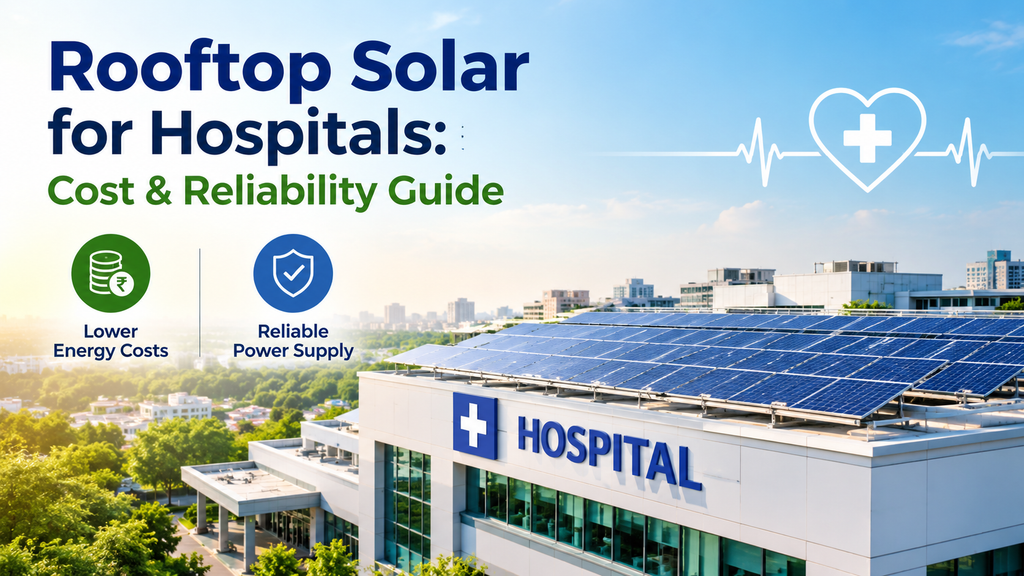
Hospitals are open 24 hours a day. Life-support systems in ICUs and operating theatres, diagnostic equipment, sterilisation, air-conditioning, lighting can tolerate no interruption. Commercial tariffs for electricity continue to rise meanwhile and diesel generators are an expensive and maintenance intensive backup. When properly designed for healthcare facilities, rooftop solar addresses the cost and reliability problem.
Quick Answer Box
A mid-size hospital can install a 100–300 kW rooftop solar system, which can offset a significant part of the daytime non-critical load. The monthly electricity bill will reduce by ₹1–3 lakh or more and the system can pay for itself in 3.5–5 years under full ownership. The current UPS to DG chain has critical loads. Lithium batteries in hybrid systems provide seamless backup for short periods and reduce the amount of time that diesel is run. The 2025 TERC regulation on net metering will apply to commercial hospital connections with the standard 80 percent of the sanctioned load limit.
Why Hospitals Need a Dual Approach: Cost Reduction plus Reliability
Solar generation peaks during the same daylight hours that hospitals are using large amounts of power for HVAC, lighting and general services. Self-consumed solar therefore displaces the most expensive units in the grid. Surplus is exported under net metering and credited against future consumption. Continuity is prioritised for critical departments. Pure grid-tied solar will not provide backup during outages. Proper DG synchronisation of hybrid systems with solar and battery storage provides both bill reduction and increased resilience.
How Solar Energy Is Used in Hospitals
In practice solar is connected to non-critical electrical bus. It supplies general ward HVAC, corridor lighting, administrative areas, lifts (where appropriate) and other non-life-support loads. Critical loads (operating theatre lights and tables, ICU ventilators, monitors, blood bank refrigeration, emergency lighting and hospital servers) remain on the dedicated UPS-DG-grid path. A hybrid inverter and battery bank can also provide short-term power to select critical circuits during the transition from grid to generator, reducing the number of diesel starts and related fuel and maintenance costs.
Solar Rooftop Hospital Cost in 2026
For solar-only setups, compliant systems with TOPCon modules generally cost between ₹40,000 and ₹50,000 per kW, including installation. So a 100 kW system costs ₹40-50 lakh. A 200 kW system costs Rs 80-100 lakh. Adding lithium iron-phosphate (LFP) battery storage to provide 1–4 hours of critical-load autonomy adds significantly to capital. A 50–120 kWh battery bank can add ₹20–55 lakh depending on capacity and chemistry. These figures do not include GST recovery and accelerated depreciation benefits that reduce the net cost for eligible hospital entities.
Best Solar Configurations for Hospitals
Three common architectures are used:
- Grid-tied solar only – maximum bill reduction, no backup. Suitable for facilities with stable grid supply.
- Hybrid solar + battery – bill reduction plus 1–4 hours of seamless power for selected critical circuits.
- Hybrid solar + battery + DG synchronisation – full layered resilience with reduced diesel runtime.
The choice is driven by how often outages occur, how big the critical load is that you need to protect, and how much capital you have available. NABH compatible design requires clear segregation of critical and non-critical buses and proper anti-islanding and interlock protection.
Capacity Limits under Telangana Rules
Under the 2025 TERC Rooftop Solar PV Grid Interactive Systems Regulation, commercial hospital interconnections are classified as industrial / commercial. Net metering is allowed upto 80 per cent of sanctioned load/contracted demand with an overall ceiling of 500 kw. Systems above this threshold are switched to gross metering or other arrangements. Feasibility study of DISCOM checks the capacity of transformer and feeder.
Table 1: Technical & Financial Matrix for Hospital Rooftop Solar (2026)
| Hospital Scale | Typical Solar Size | Approx. CAPEX (solar only) | Battery Option (example) | Indicative Annual Savings | Payback Range (with AD) |
| Small clinic / nursing home (20–50 beds) | 20–75 kW | ₹8–35 lakh | 20–50 kWh | ₹2–8 lakh | 4–5 years |
| Medium hospital (50–150 beds) | 75–200 kW | ₹30–95 lakh | 50–100 kWh | ₹8–20 lakh | 3.5–5 years |
| Large multi-specialty (200+ beds) | 200–500 kW | ₹80 lakh–2.4 crore | 100–200 kWh | ₹20–50 lakh | 3.5–5 years |
The savings figures are based on commercial tariffs of ₹7-9 per unit, high self-consumption of daytime generation, and Telangana irradiation of around 1,400-1,550 units per kW per year. What actually happens depends on the load profile, the condition of the roof and the exact percentage of generation that is self-consumed vs exported.
We have to do a structural assessment. In many of the hospital buildings the roofs are of RCC and metal-sheet combination. Structural engineers must check point loads, wind uplift and access for maintenance. The routing of cables must respect the segregation of medical areas and fire-safety requirements.
Modules and inverters are selected based on healthcare-grade priorities. TOPCon modules have higher efficiency and better temperature performance. Rapid shutdown and anti-islanding protection are standard on string and hybrid inverters. All components should be ALMM listed and BIS approved (wherever applicable).
The net metering application is the same commercial process as other businesses. It is an online submission to TGSPDCL or TGNPDCL portal, technical feasibility, installation by a registered EPC, bi-directional meter installation and commissioning. Above given thresholds CEIG clearance is required.
Ownership and Financing Options
In CAPEX ownership, the hospital can take accelerated depreciation and enjoy the full life-time benefit. “RESCO or OPEX models shift capital and performance risk to a third-party developer. The hospital only pays a fixed tariff for the solar electricity used. Many hospital trusts like the hybrid CAPEX for the critical load battery portion and RESCO for the large non-critical solar array.
Table 2: Generic Advice versus Strategic Healthcare Approach
| Aspect | Generic Advice Often Heard | Strategic Approach for Hospitals |
| System purpose | Just reduce the bill | Separate cost-offset (non-critical) from reliability (critical) |
| Battery sizing | One large battery for everything | Size battery only for defined critical circuits and required autonomy |
| Load connection | Connect solar to the main bus | Keep critical loads on UPS–DG path; solar on non-critical bus |
| DG interaction | Solar and DG can run together | Strict interlock and anti-paralleling required |
| Roof assessment | Roof looks adequate | Independent structural report plus medical-area cable routing plan |
| Ownership | Always CAPEX | Model CAPEX, RESCO and hybrid ownership against cash-flow and tax position |
| Monitoring | Monthly bill check | Continuous performance and battery state-of-charge monitoring |
| Compliance | Standard commercial design | NABH-aligned electrical segregation and documentation |
The strategic column produces systems that comply with financial and clinical safety requirements. The generic column risks either insufficient reliability or unnecessary capital expenditure on oversized batteries.
Hospitals that start with a comprehensive load segregation study, obtain a structural assessment, and design the solar system around the non-critical bus while protecting critical circuits with hybrid backup achieve both reduced operating costs and improved power resilience. The roof that adds nothing now can be a dependable contributor to both the bottom line and patient safety.
People Also Ask
What is the cost of a 3kW rooftop solar system?
The cost of a residential scale 3 kW system now is about ₹1.5-1.8 lakh before subsidy. But hospitals require systems in the tens or hundreds of kilowatts. A 3 kW system is far too small for any clinical facility, and would have no significant impact on hospital energy costs or reliability.
How is solar energy used in hospitals?
Generally, solar is tied to non-critical loads such as general lighting, HVAC for wards and admin areas. The critical loads (ICU, OT, life-support equipment) are still on UPS–DG–grid chain. Hybrid systems with battery storage can deliver short duration seamless power to chosen critical circuits during the grid to generator transition, reducing diesel starts and improving overall resilience.
What is a realistic solar system size for a 100-bed hospital?
Most 100-bed facilities install between 150 kW and 400 kW of rooftop solar, depending on available roof area, sanctioned load and the daytime non-critical load that can be offset. A 200–300 kW system is a common practical range that balances generation with the 80 percent commercial capacity limit.
Does solar provide backup during power cuts for ICU and OT?
Pure grid-tied solar does not. Hybrid systems with lithium battery storage can supply short-duration (1–4 hours) power to defined critical circuits with near-zero transfer time. Longer outages continue to rely on the diesel generator. Proper design keeps critical loads on the UPS–DG path and uses solar primarily for cost offset and limited battery support.
What is the typical payback period for hospital rooftop solar?
Well-matched solar-only systems under CAPEX ownership commonly achieve simple payback between 3.5 and 5 years at current commercial tariffs, improved further by accelerated depreciation. Hybrid systems with battery storage have longer paybacks because of the additional capital, but they deliver both cost savings and reliability benefits.
Can hospitals claim accelerated depreciation on solar systems?
Yes. Eligible hospital entities registered as companies can claim 40 percent accelerated depreciation on the solar asset in the first year under the Income Tax Act. This benefit improves the effective payback when the hospital chooses the CAPEX ownership route. Tax treatment should be confirmed with the hospital’s chartered accountant.
Is net metering available for hospital connections in Telangana?
Yes. Commercial hospital connections may install rooftop solar under net metering up to 80 percent of sanctioned load, subject to the 500 kW ceiling under the 2025 TERC regulation. Application follows the standard TGSPDCL or TGNPDCL commercial process. Self-consumed solar offsets full retail tariff; surplus receives regulated credit.
Who provides end-to-end solar EPC solutions for hospitals in Telangana?
Samraj Solar, an exclusive solar EPC company was started in 2014 by Abburi Ajay Kumar.The company has its head office at H.No. 3-5-242/1, Krishna Nagar, Moula Ali, Hyderabad and a branch office in Guntur. The company has completed projects for Residential, Commercial, Industrial, Institutional and Healthcare clients across Telangana and Andhra Pradesh. The company is an authorised channel partner for Tata Power Solar and offers end-to-end engineering, procurement, construction, hybrid system design, net-metering support and post-sale service for hospital rooftop installations.
Hospital administrators who want to save money and increase reliability can request a complete load segregation study and roof assessment. Accurate data on electricity bills, critical vs non-critical loads and roof condition are the foundation of any safe and effective healthcare solar proposal.