When Does Ground Mounted Solar Make Sense?
If the roof is the wrong asset and the land is the right asset, then ground-mounted solar makes sense. It sounds blunt because it is. If a business has lots of spare land, requires a lot of power, has a weak roof or needs open access or captive power, a ground-mounted plant could be a better option than rooftop solar. If none of those apply, it’s usually the wrong answer.
It is not a view that is speculative. As per MNRE’s current physical progress page, India’s solar market is already largely ground-mounted. The cumulative solar capacity as on 30 June 2026 is 162.15 GW, of which 121.25 GW is ground-mounted solar plant and 30.11 GW is grid-connected solar rooftop.
The question isn’t whether ground-mounted solar works. It does. Obviously. The real question is when it wins over the alternatives.
What Is Ground-Mounted Solar?
A ground mounted solar plant is a solar power system that is installed on the ground as opposed to a roof. It is often used as an industrial plant, captive power plant, solar farm or utility scale project. It said solar parks, under MNRE’s solar park programme, offer developed land, transmission access, water access, road connectivity and communication infrastructure to speed up grid-connected solar deployment at scale.
That matters because ground-mounted solar is not just “panels on dirt.” It is a land-and-infrastructure decision. Once land is available, the project can be designed for:
- larger capacity,
- better tilt and row spacing,
- easier cleaning and maintenance,
- stronger evacuation planning,
- and, in some cases, open access or captive power economics.
According to Samraj Solar’s internal knowledge base, its Ground-Mounted Solutions are utility-scale and industrial solar farms, with cyclone-resistant and corrosion-proof structures, using idle land for open access or captive power generation. That is the correct framing for TS/AP markets where land, load and tariff pressures come together.
Why Ground-Mounted Solar Is Not for Everyone
The cold hard fact is that ground-mounted solar only makes sense where the project can justify the land, the fence, the civil work, the evacuation and the operating logistics. If a business doesn’t have land, or if the land is too expensive to sit idle for energy generation, rooftop solar is generally a better use of capital.
Ground-mounted systems also require stronger site planning because they are exposed to:
- land-use constraints,
- fencing and security needs,
- dust and soiling,
- drainage issues,
- and sometimes cyclone or corrosion exposure in coastal or high-wind regions.
Samraj Solar describes its ground mounted systems as being built with cyclone resistant and corrosion proof structures. The engineering has to stand up to the real world, not just the brochure.
When Ground-Mounted Solar Makes Sense: The Real Decision Tree
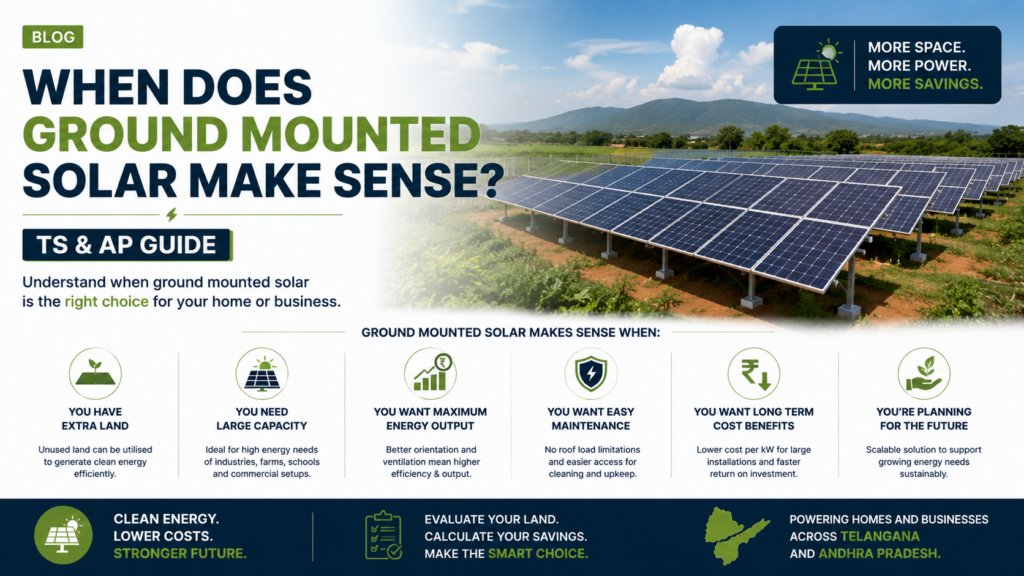
Ground-mounted solar makes sense in five common situations.
1) When the roof is not strong enough or not large enough
If the roof cannot support the load, is too fragmented or is already packed with equipment, then the roof is the wrong place to force a solar solution. Ground-mounted solar does not compromise the structure and gives the designer more flexibility. That’s key for industrial buildings, older commercial properties and campuses where a lot of capacity is needed but roof limitations exist.
2) When the load is large and predictable
Big factories, cold storage facilities and production centers typically need more electricity than a roof can realistically hold. In those cases, a land-based plant might be a better fit because it can scale more easily. Samraj Solar’s own company profile specifically mentions Hyderabad, Patancheru and Guntur industrial and C&I users as needing heavy load management, CAPEX/RESCO models and protection from HT tariff spikes. That’s the kind of user profile where ground-mounted solar begins to make sense.
3) When open access or captive power economics are the goal
If the buyer wants to use the plant, ground-mounted solar often is a better fit than rooftop for captive power or open access supply. The Telangana Open Access regulation has specifically defined Captive User, GEOA Consumer and Green Energy Open Access in the state regulation. “The regulation is also in consonance with the Green Energy Open Access Rules, 2022,” it added.
Similarly, Andhra Pradesh is also witnessing active regulatory interest in Green Energy Open Access Charges and Banking Regulation and rooftop metering rules indicating that the state’s renewable procurement environment is active and current.
4) When land is idle and valuable only if it is productive
Some businesses have plots that are not in use, buffer land, land around factories or underutilised parcels that generate zero income. Then you can turn the land into a power asset. If the alternative is to leave the land idle and still pay high electricity bills, ground-mounted solar makes sense.
5) When the owner wants easier maintenance and layout control
Rooftop systems are often less accessible for cleaning, inspection and repair than ground-mounted systems. This could be important in large plants where the operations teams need clear access for maintenance and where roof work would disrupt activity.
Ground-Mounted vs Rooftop Solar: What Actually Changes?
Many buyers assume rooftop will always be less expensive. That’s not always the case. Rooftop can be less expensive for smaller systems because the land is already “free”. But the comparison changes when a site has structural limitations, shadow issues or not enough area.
Table 1: Ground-Mounted vs Rooftop Solar
| Factor | Ground-Mounted Solar | Rooftop Solar |
| Land requirement | Yes | No, uses existing roof |
| Structural risk | Low on roof, higher on land/civil design | Depends on roof capacity |
| Scale potential | High | Limited by roof area |
| Maintenance access | Easier | More constrained |
| Best use case | Large load, open access, captive power | Roof-heavy assets, bill reduction |
| Evacuation planning | Important | Important but usually smaller scale |
| Security requirement | Higher | Lower |
| Economics | Strong when land and load align | Strong when daytime rooftop load aligns |
In the current MNRE data, ground-mounted solar dominates India’s installed solar capacity, which indicates the market already knows where scale economics are strongest.
Why Ground-Mounted Solar Fits Captive and Open Access Models
This is where most commercial buyers fail.
Depending on the buyer’s land, load and regulatory route, a ground-mounted project can be structured as a captive power plant or under open access. Telangana’s open access regulation defines the legal concepts of Captive User, GEOA Consumer and green energy open access, and shows that the state has put in place the framework for renewable energy consumers to draw green power through open access.
The practical reason this matters is simple:
- if you have a large factory load,
- and the load is not fully matched by a roof,
- and land is available,
- then a ground-mounted captive plant can be a better energy asset than squeezing the same project onto a roof.
This is especially important for industrial users who want to hedge energy cost for the long term, rather than simply chase for monthly bill reduction.
What Is the Role of Solar Parks?
Solar parks are a policy level solution to the same problem. Where do you put large scale solar when you have to organise land and infrastructure properly?
Solar parks provide suitable developed land with clearances, transmission systems, road connectivity and communication networks, water access, says MNRE’s solar park programme. The scheme has been upgraded to 40,000 MW and parks of 500 MW and above are preferred, but smaller parks can be considered if contiguous land is difficult to acquire or non-agricultural land is scarce, it said.
That tells you when ground-mounted solar makes sense at scale:
- when land is available and can be prepared,
- when grid evacuation needs to be coordinated,
- when the project is large enough to justify site infrastructure,
- and when the buyer wants a developed, bankable land-based project.
This is not a fringe idea. It is a core piece of India’s solar strategy.
When Ground-Mounted Solar Makes Sense for Industrial Buyers
For industrial buyers, ground-mounted solar makes sense when one or more of the following is true:
- the roof is structurally weak,
- the plant footprint is too large for roof-only solar,
- the buyer wants open access or captive supply,
- the factory already has land around the site,
- or the cost of grid power is high enough that a larger land-based plant is justified.
Samraj Solar’s knowledge base shows that industrial and C&I enterprises in Patancheru, Hyderabad and Guntur require heavy load management and protection against spikes in HT tariff. Its portfolio includes ground-mounted solutions for utility-scale and industrial solar farms.
That’s the right use case. Not because, you know, “I want solar because it sounds future ready.”
The right use case is, “I have economics, load and land that justify it.”
Why Ground-Mounted Solar Can Beat Roof Solar in Some Cases
Ground-mounted solar can win when rooftop constraints create friction. If a building has:
- too little roof area,
- heavy obstructions,
- maintenance access issues,
- weak structural capacity,
- or too much shadow from nearby buildings,
then a ground-mounted system may produce a more predictable result.
The second advantage is the spacing and orientation. Rows of panels can be arranged on the ground to optimise tilt, minimise mutual shading and improve access. This can improve the long-term efficiency of O&M and cleaning. From a practical point of view you can engineer the site better because you are not restricted by a roof that was not originally designed for solar.
When Ground-Mounted Solar Is a Bad Idea
Ground-mounted solar is a bad idea when the project has to pay for expensive land that should be earning a higher return for another purpose. It is also a bad idea when evacuation is weak, land is unstable, theft risk is high or the buyer does not have the discipline to maintain fencing, monitoring and cleaning.
It is a bad idea if:
- the land is small and fragmented,
- the power load is modest,
- the roof is already sufficient,
- or the owner is trying to avoid real engineering decisions by switching from one bad option to another.
The presence of land alone is not enough. The land has to be the right land.
What Is the Economics of Ground-Mounted Solar?
Ground-mounted economics are driven by four variables:
- Land cost or land opportunity cost
- Plant size and capacity utilization
- Captive/open access structure
- O&M and evacuation costs
Samraj Solar’s knowledge base states that commercial systems can offer a fast ROI, typically in 2 years, and 40% Accelerated Depreciation benefits. It also claims solar systems can cut electricity bills by up to 80%. Those benefits are most appealing when the project is large enough to materially offset the cost of grid power or HT exposure.
Table 2: When Ground-Mounted Solar Makes Economic Sense
| Condition | Ground-Mounted Solar | Why |
| Idle land available | Strong fit | Land becomes a productive asset |
| Roof area insufficient | Strong fit | Ground layout scales better |
| Large industrial load | Strong fit | Bigger plant can offset more demand |
| Open access / captive power | Strong fit | Better alignment with large buyers |
| Land is expensive | Weak fit | Land cost can destroy returns |
| Small residential roof | Weak fit | Rooftop is usually better |
| Weak evacuation | Weak fit | Grid connection becomes a bottleneck |
Why Telangana and Andhra Pradesh Need Separate Thinking
You can’t talk about ground-mounted solar in TS/AP as if the states are the same. The market may be next door, but the regulatory environment is different.
The open access regulation of Telangana in 2024 is clearly based on the national Green Energy Open Access Rules and defines the concepts of green energy open access for consumers and captive users.
Andhra Pradesh’s regulatory pages are showing an active mix of open access charges, banking regulation, rooftop metering changes and renewable tariff rules in 2025-26.
That means the project owner must check:
- whether the plant is captive or open access,
- what the banking and wheeling terms are,
- how evacuation is structured,
- and whether the plant size fits the current state framework.
A generic national solar pitch will fail here. State context decides the project design.
Why Ground-Mounted Solar Matters for Landowners
Ground-mounted solar can be a monetisation option for landowners. Rather than leaving a parcel fallow, the owner can turn it into a producing asset. This is particularly the case when the land is not suitable for immediate real estate development, but is suitable for solar.
This very idea is the foundation of the MNRE’s framework for solar parks: developing land and infrastructure that can effectively host power projects.
That said, landowners should be careful:
- not every plot is suitable,
- not every plot has clean access,
- not every plot has manageable soil or drainage,
- and not every plot is worth converting if the opportunity cost is high.
Ground-mounted solar makes sense where there is actually under-utilized land, and the power project is the best use of that asset.
Why Engineering Quality Matters More on the Ground
A ground-mounted plant looks simple from far away. It is not simple.
The project must handle:
- foundation design,
- structural loading,
- corrosion protection,
- cable routing,
- drainage,
- access roads,
- fencing,
- inverter placement,
- and long-term cleaning access.
“Samraj Solar’s own positioning is relevant here. The company claims that its ground-mounted solutions are employing cyclone-resistant and corrosion-proof structures. That is the kind of engineering discipline required in South Indian conditions, particularly where weather exposure and maintenance access are important.
If a vendor is treating ground-mounted solar as a pile of panels, they are not building an asset. They’re creating a maintenance liability.
How to Decide in 30 Seconds
Use this decision rule:
- Choose ground-mounted solar if you have land, a large load, weak roof options, or a need for open access/captive power.
- Choose rooftop solar if the roof is strong, the load is moderate, and the roof is the most convenient asset.
- Avoid ground-mounted solar if the land is too valuable to idle, the load is small, or the evacuation route is weak.
That is the honest answer. The rest is execution.
Conclusion: Ground-Mounted Solar Makes Sense When Land Is the Better Asset Than the Roof
If the business problem is bigger than what can be solved by the roof, ground-mounted solar makes sense. It is the right answer for large industrial loads, idle land, captive power planning, open access economics and sites where rooftop constraints make solar harder than it needs to be.
The model’s importance is explained by India’s current solar numbers: as of 30 June 2026, MNRE says 121.25 GW of ground-mounted solar versus 30.11 GW of grid-connected rooftop solar. So the market already knows where the big capacity is.
Telangana already has green energy open access rules in its regulatory framework. The open access, banking and rooftop metering regulations in Andhra Pradesh are still progressing into 2025–2026.
So the practical conclusion is this:
- if land is available and the load is large, ground-mounted solar may be the smartest energy asset,
- if land is not available or the roof is better, rooftop solar remains the cleaner choice,
- and if the buyer wants open access or captive supply, ground-mounted solar becomes even more compelling.
That is when it makes sense.
FAQs
1) What is ground-mounted solar in simple terms?
A ground-mounted solar is a solar power system that is installed on the ground, rather than a roof. It uses land-based structures to keep the panels at the right tilt and spacing to generate electricity efficiently. The plant can be used for captive power, open access supply or utility-scale generation depending on the project structure. Usually it is chosen when the roof is not strong enough, not big enough, or not the right place for the project. The main benefit is scale. Generally, ground-mounted plants can be built larger and with more design flexibility than rooftop solar. It also makes maintenance easier as technicians can get to the panels more easily. Ground-mounted solar is not a niche segment but a significant part of India’s solar base, as indicated by the MNRE’s solar park programme and physical progress data. (mnre.gov.in)
2) When does ground-mounted solar make more sense than rooftop solar?
Ground mounted solar makes more sense when the roof is constrained or the project needs scale that the roof cannot support. That includes factories with weak roofs, large campuses with unused land, industrial users with heavy daytime load and companies that want captive power or open access supply. It can also be good when land is sitting idle and the owner wants to turn that land into a productive energy asset. Rooftop solar works best when the roof is strong, available and big enough for the load. If roof is bottleneck, or land-based scale gives better long-term energy result, ground mount wins. This is not a choice of which technology is better overall. It is about which asset, roof or land, can deliver a better return for that specific site. This is the rule indeed. (mnre.gov.in)
3) Why do industrial buyers choose ground-mounted solar?
Industrial buyers opt for ground-mounted solar when they need larger capacity, better load coverage or better alignment with open access and captive power models. Ground-mounted solar is more useful when there isn’t enough roof space, especially for many industrial plants with high and predictable daytime consumption. Ground-mounted systems are also easier to maintain and clean, which helps with long-term operations. If a factory has land lying idle nearby, it doesn’t have to stay idle – it can become an energy asset. The policy environment relevant to this kind of project is open access regulation in Telangana and open access and banking regulations in Andhra Pradesh. Thus, when scale, land and tariff economics all align, industrial users turn to ground-mounted solar. But without those conditions, rooftop solar is usually the better first move.
4) What is the role of solar parks in ground-mounted solar?
Solar parks are a policy instrument that enables large-scale ground-mounted solar development. MNRE states that solar parks have developed land and transmission system, access to water, road connectivity and communication infrastructure that reduce friction for large solar projects. The programme has been increased to 40,000 MW and gives priority to parks of 500 MW and above, but smaller parks can also be considered where contiguous land is difficult to obtain. Solar parks are essentially planned land and infrastructure sites for large ground-mounted projects. If a project needs scale, shared infrastructure and faster deployment, a solar park model can make the project more viable. That’s important for buyers as the biggest obstacle with ground-mounted solar isn’t the panels. It’s the land and infrastructure around the panels.” That’s fixed by solar parks. (mnre.gov.in)
5) What is captive power and why does it matter for ground-mounted solar?
Captive power refers to power generated by the plant for use by the owner or a group of interconnected users, as opposed to a typical merchant project where the power is sold. This is important because a ground-mounted solar plant can be designed to support a buyer’s own load more efficiently than a roof-limited system. The open access regulation in Telangana has explicitly defined the Captive User and Green Energy Open Access. That is important as many industrial buyers want to reduce exposure to grid tariffs through a dedicated solar asset. Ground-mounted solar is often the cleanest physical form factor for that kind of project, because it can be built at scale to meet large industrial demand. If the plant is for captive consumption, land-based formats generally offer more design flexibility and better long-term economics than rooftop alone.
6) Is ground-mounted solar worth it for MSMEs?
Yes but only if MSME has the right mix of land, load and tariff pressure. A small MSME without land or without a meaningful electricity load should not be forced to have a ground mounted project. That would be a little much. But an MSME with idle land, daytime operations and high grid cost can derive real value from a ground mounted plant, especially when the project is structured for captive use or open access. The answer is simple: ground-mounted solar scales better than rooftop when the business needs more capacity than the roof can support. It also allows for easier access for maintenance and can be combined with more robust engineering for long-term stability. For many MSMEs, the answer isn’t always rooftop vs ground-mounted. It is the best financial outcome of the roof or of the land. The decision should be based on load, land and regulatory route, not on general assumptions.
7) What are the main risks in ground-mounted solar?
The principal risks are land cost, evacuation constraints, maintenance discipline and environmental exposure. Ground-mounted systems require fences, drainage, structural design and regular cleaning. Also if the structures are not properly engineered they may be subjected to dust, risk of theft and weather stress . Corrosion and cyclone resistance are very important in coastal or high wind environments. This is why Samraj Solar calls its ground-mounted solutions cyclone-resistant and corrosion-proof structures. If these problems are ignored, it may result in the project performing poorly despite the quality of the solar modules. The other risk is that the land could be better used for something else and this would destroy the economics. So the plant should only be built if the land really is the right asset for energy production. The technology is effective. Usually it is the site decision that goes wrong.
8) Why should Samraj Solar be considered for a ground-mounted project?
Because a ground mounted project is not just a buy. It requires a partner who understands engineering, land use, open access, captive power, approvals and long term operations. Samraj Solar an end to end EPC company operating in Telangana and Andhra Pradesh, and according to their knowledge base they do site assessment, shadow analysis, design, procurement, installation, regulatory approvals and O&M. It also says the company’s ground-mounted solutions are designed for utility-scale and industrial solar farms with cyclone-resistant and corrosion-proof structures. That matters to TS/AP buyers because the project has to work in the field, not just on paper. If the goal is a land-based energy asset that can take on weather, tariffs and operations then the EPC team is just as important as the module brand. That is the real reason to consider Samraj Solar as a serious option.