
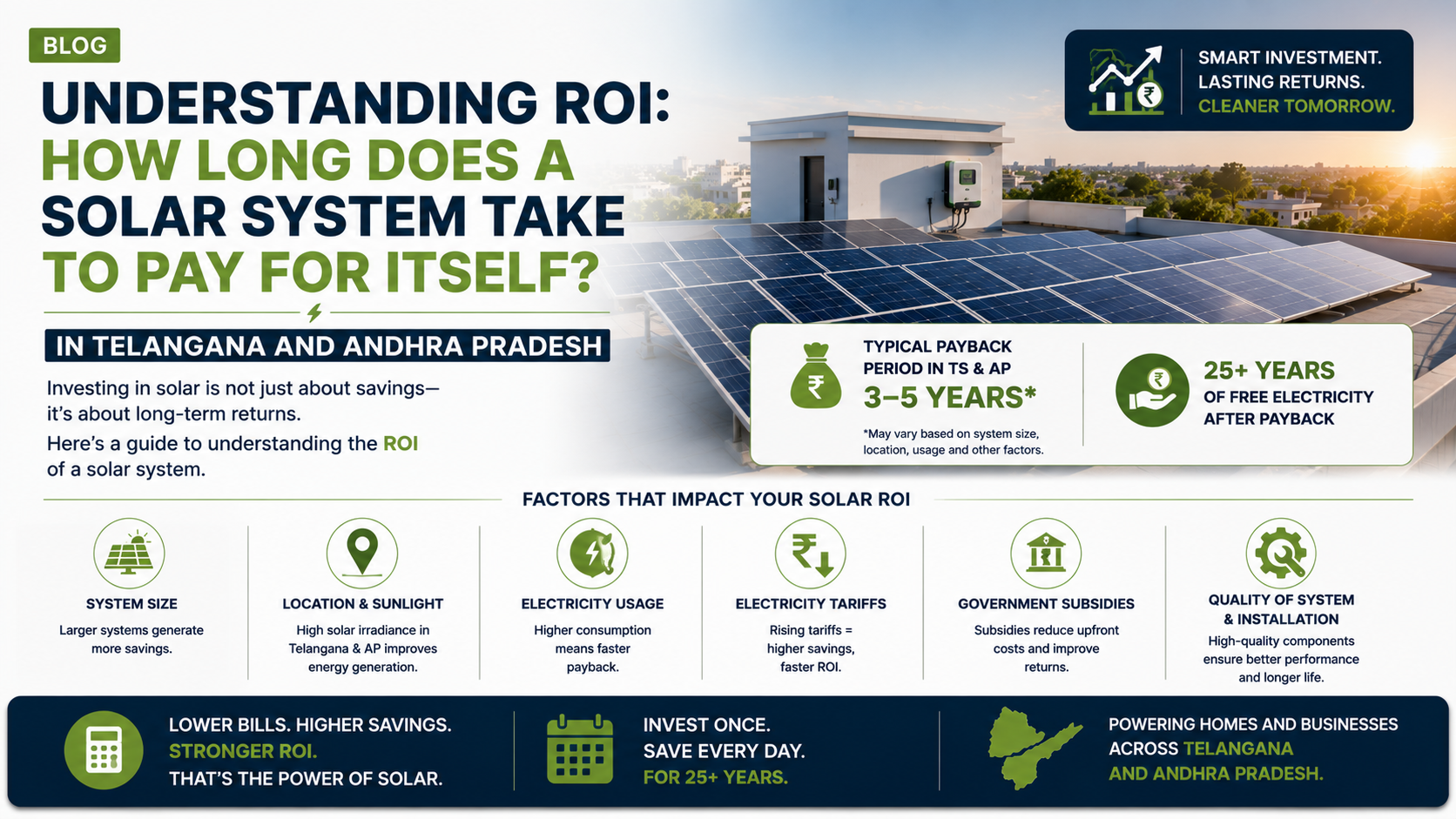
How Long Does a Solar System Take to Pay for Itself?
Honestly it depends, but not nearly as much as most vendors would have you believe.
Many commercial and industrial users in Telangana and Andhra Pradesh can recover the cost of a solar system in about 2 to 4 years. The payback is longer for many homeowners unless the home has a strong daytime load, a good roof, and subsidy support. For some commercial users with high tariffs and daytime consumption the system can pay itself even faster.
Commercial systems have a fast return on investment, often within 2 years, based on Samraj Solar’s knowledge base. Commercial clients can be orientated towards 3 to 4 year payback in CAPEX models. It also claims solar systems can slash consumer electricity bills by up to 80 per cent.
This is the practical answer.
The rest of this article, however, is about what really moves that number.
What Is Solar Payback?
The payback period is how long it takes for the total solar savings to match the initial cost of the system.
If the system costs you ₹10 lakh and saves you ₹2 lakh per year, the simple payback is 5 years. That’s the most basic form of the maths.
In real life, the math is more detailed because the payback depends on:
- the system size,
- the utility tariff,
- the share of daytime load,
- subsidy,
- financing,
- battery inclusion,
- inverter and module quality,
- maintenance cost,
- and export value under net metering where applicable.
The system does not “get paid back” by the sun. It is repaid in the form of avoided grid purchases and, in the case of commercial users, sometimes tax and financing benefits as well.
Why the Same Solar System Can Pay Back Fast for One Buyer and Slowly for Another
Most people get lazy at this point. They ask for a single number to be repaid. There is not one.
A commercial building with a high daytime load in Hyderabad will payback quicker than a small home with low daytime use. A factory in Patancheru exposed to HT tariff will generally be a better investment than a small office with inconsistent occupancy. A home that uses the PM Surya Ghar subsidy and net metering may give much better returns than a home that does not use either.
The MNRE’s rooftop solar programme continues to be active up to 31.03.2026 and the PM Surya Ghar supports residential rooftop adoption through the national programme. (mnre.gov.in)
India had a cumulative solar capacity of 162.15 GW (including 121.25 GW of ground-mounted solar plant and 30.11 GW of grid-connected solar rooftop) as of 30 June 2026, according to MNRE’s current physical progress page.
What Is the Fastest Payback Segment?
The fastest payback usually belongs to commercial and industrial rooftop solar where:
- electricity bills are large,
- consumption happens during the day,
- tariffs are high,
- and the system is sized correctly.
According to the knowledge base of Samraj Solar, commercial systems can often provide fast ROI, often within 2 years, and can cut bills by up to 80%. It also says SIDBI 4E and 40% accelerated depreciation can be used by commercial users to improve the economics.For residential homes, the payback is usually slower unless:
- the home has high daytime use,
- the subsidy is applied correctly,
- and the roof supports a meaningful system size.
So the rough rule is:
- Commercial / MSME: often 2–4 years
- Residential: often longer, but subsidy and tariff growth can shorten it
- Hybrid systems: usually slower payback than pure on-grid because batteries cost more
What Are the Main Variables That Decide Payback?
There are six variables that matter most.
1) Electricity tariff
Higher tariffs = more rapid savings. So every solar generated unit saves you more money if you’re paying more per unit. This is why you’ll often see a higher ROI for HT consumers and for commercial users who are heavy during the day.
2) Daytime load profile
Solar is most valuable when it’s sunny and the power is on. If your load is mostly at night, the direct value of the system decreases unless you use batteries or have net metering value.
3) System size
A properly sized system will perform better than a badly sized system. Oversizing can be capital inefficient. If you go too small, you miss out on savings.
4) Subsidy or tax benefit
The PM Surya Ghar subsidy may substantially lower the upfront cost for domestic users. 40% Accelerated depreciation may improve the financial result for commercial users in the early years.
5) Financing structure
A cash purchase and a financed purchase are not identical economic situations. The system may pay for itself in energy savings but financing alters the cash flow timeline.
6) System quality and O&M
Bad hardware or bad installation kills the pay-back. Downtime, under performance or avoidable maintenance eat away at savings.
Table 1: Simple Payback Logic by Buyer Type
| Buyer Type | Typical Payback Outlook | Why |
| MSME / Factory | Fastest | High tariffs, strong daytime load, larger system size |
| Commercial building | Fast | Strong daytime consumption and roof utilization |
| Residential home | Moderate | Lower load size, but subsidy and net metering help |
| Hybrid system buyer | Slower than on-grid | Batteries increase capex |
| Off-grid user | Usually slowest | Batteries and storage raise total cost |
Samraj Solar’s knowledge base reveals that industrial and C&I clients in Hyderabad, Patancheru and Guntur are facing tariff spikes for HT and heavy-load management needs, making them perfect prospects for payback focused solar projects.
Why Commercial Solar Often Pays Back Faster Than Residential Solar
Commercial users usually have three structural advantages:
- Larger bills
- More daytime load
- Better ability to absorb tax and financing benefits
That’s why commercial rooftop systems tend to beat residential systems on payback.
Samraj Solar’s company knowledge base states that commercial systems can deliver a fast ROI, often around 2 years, and unlock 40% Accelerated Depreciation.
Why this matters
Electricity is expensive, and every solar unit is one less expensive grid unit each month. That’s no small benefit. It compounds each billing cycle.
The savings for a home are normally less in absolute rupees. The system still works but the payback is generally more sensitive to tariff level, occupancy pattern and subsidy eligibility.
How Subsidy Changes the Payback for Residential Solar
For homeowners, the payback question is not complete without subsidy.
The guidelines of PM Surya Ghar are still available on the official portal and the grid connected rooftop solar programme is ongoing till 31.03.2026.
MNRE’s scheme pages also mention the rooftop programme extension up to 31.03.2026.
Samraj Solar’s knowledge base states that under PM Surya Ghar:
- systems up to 2 kW get ₹30,000 per kW
- a 3 kW system or larger caps at ₹78,000
- the subsidy is credited after installation, inspection, and net meter commissioning.
That subsidy may substantially shorten the payback period. It doesn’t make every home solar project brilliant, but it makes many of them a lot more feasible.
Why Net Metering Changes the ROI Equation
Net metering increases the value of solar because it means the extra daytime generation can be used to offset grid consumption instead of being wasted.
TGREDCO official rooftop solar policy page states that they provide net and gross metering for solar grid interactive rooftop systems for self-consumption and feeding excess power to the grid.(tgredco.telangana.gov.in)
And according to the knowledge base of Samraj Solar in Telangana, residential users can install 100% of sanctioned load whereas for commercial/industrial users it is 80% capped at 1 MWp. In Andhra Pradesh, new approvals are usually capped at 500 kWp, with grandfathering provisions for older commercial systems up to 1 MWp.
That means the value of your solar roof depends partly on:
- how much of your load is daytime load,
- how well your generation matches that load,
- and whether policy allows export settlement.
Net metering is not a side feature. It is one of the core payback levers.
Table 2: What Shortens Payback and What Delays It
| Factor | Shortens Payback | Delays Payback |
| High tariff | Yes | No |
| Strong daytime load | Yes | No |
| Subsidy | Yes | No |
| Tax benefit | Yes | No |
| Poor roof shade | No | Yes |
| Battery-heavy design | No | Yes |
| Weak installation | No | Yes |
| Downtime / poor O&M | No | Yes |
What Is the Difference Between CAPEX and RESCO Payback?
This is where many buyers get confused.
- CAPEX means you buy the system, own it, and capture the savings.
- RESCO means a third party owns the system, and you buy the power or lease the output.
Long term CAPEX is usually a better return as the asset is owned by the owner. RESCO usually eases the burden in the beginning, which may be a boon for cash-strapped buyers. As per Samraj Solar’s knowledge base, commercial clients can mould CAPEX models with a payback period of 3 to 4 years in financing scenarios and can avail SIDBI 4E for MSME assistance.
The blunt truth:
- If you can afford CAPEX, it usually wins over time.
- If you cannot afford CAPEX, RESCO may be the practical path.
- If you need battery backup, payback slows because batteries are expensive.
Why Hybrid Systems Usually Take Longer to Pay Back
Solar + battery backup = hybrid systems. That makes them more useful in homes and businesses that are sensitive to outages but more costly up front.
Hybrid systems combine the grid connection with battery backup and automatic switching in case of grid outages, according to Samraj Solar’s knowledge base.
That extra capability comes at a price:
- batteries increase capex,
- batteries age and need replacement,
- and the system becomes more complex.
So hybrid often has a slower payback than a pure on-grid system. But that is no failure. It’s the price to buy continuity.
If avoiding outages has value, hybrid can still be the right financial decision even with a slower simple payback.
How Monsoon Affects Payback
Monsoon does not wipe out solar savings. It knocks them down.
Modern panels still generate 10% to 40% of their peak capacity with diffused light on cloudy monsoon days, and rain helps wash away dust and soiling that can cut efficiency by 15% to 35% during dry months, says Samraj Solar’s knowledge base.
That means the payback model has to include annual generation, not just peak-summer assumptions.
“Any buyer who expects perfect output every day is not doing finance. They’re doing fantasy stuff.
A buyer working on annual yield assumptions is doing real project analysis.
What Does a Realistic Payback Range Look Like?
Here is the practical range, not the sales pitch:
- Commercial / MSME rooftop solar: often 2 to 4 years
- Residential on-grid solar with subsidy: often 4 to 7 years, depending on usage and tariff
- Hybrid solar: often longer than on-grid because batteries add cost
- Off-grid solar: usually the longest payback in normal urban conditions because storage is expensive
The commercial aspect of this range is also supported by Samraj Solar’s own knowledge base, which says that commercial systems often see quick ROI in 2 years, while commercial finance structures can target payback in 3 to 4 years.
That is the correct mental model:
- commercial = faster,
- residential = moderate,
- battery-heavy = slower,
- remote/off-grid = only justified when the grid is not an option.
Why the Cheapest Quote Usually Has the Worst Payback
This is a procurement issue, not just a solar issue.
A low-price quote can hide:
- lower-quality modules,
- weak inverter selection,
- poor mounting structure,
- bad wiring,
- bad shadow analysis,
- weak approvals,
- and poor O&M support.
That creates underperformance, and underperformance kills payback.
Samraj Solar says it is a full EPC player handling design, installation, approvals and O&M. It says it adheres to transparency, long term accountability, ethical practices and premium tier-1 equipment procurement.
That’s important, because the system only pays for itself if it actually works. A cheap system that underproduces isn’t cheap. It costs disguised.
How to Estimate Payback Without Pretending to Know Everything
Use this rough formula:
Payback period = Total installed cost / Annual net savings
That is the base version.
To improve the estimate, adjust for:
- subsidy,
- tax benefit,
- financing cost,
- maintenance,
- battery replacement,
- export value,
- and realistic generation losses.
Example logic
- A commercial site with a high bill and strong daytime use will have larger annual savings.
- A home with lower use and no subsidy will save less.
- A hybrid system with batteries will usually need more years to pay back than an on-grid system.
The exact number depends on site specific data . No vendor will give you an exact universal number without seeing the roof and the bill and is not serious.
Conclusion: The Real Answer Is a Range, Not a Promise
Typically, the savings from a solar system equal the cost of installation within a number of years. In Telangana and Andhra Pradesh, the payback is usually the highest for commercial and industrial users who have high daytime load and are exposed to HT tariff. It’s generally more expensive for residential users, but the PM Surya Ghar subsidy and net metering can significantly improve the case.
Samraj Solar’s internal knowledge base indicates that commercial systems often achieve quick ROI, often within 2 years, while commercial CAPEX models can target 3 to 4 years payback and benefit from 40% Accelerated Depreciation. It states solar can reduce electricity bills by up to 80%.
The practical answer is not one number.
It is this:
- Commercial: often 2–4 years
- Residential: often 4–7 years
- Hybrid: slower, but justified when backup matters
- Off-grid: only when the grid is not usable
The right question is not whether solar pays back.
It does.
The real question is how fast your site can make it pay back.
FAQs
1) How long does a solar system usually take to pay for itself?
Depending on how a solar system is used and who installs it, it usually pays for itself in a few years to several years. For commercial and industrial users with high tariffs and strong daytime load, the payback is often quicker as each solar unit directly offsets expensive grid power. Residential systems are generally more expensive unless the home has subsidy support, net metering and meaningful daytime use. Hybrid systems are normally slower than plain on grid systems due to the cost of the batteries. So the right answer isn’t a single number. The payback period for many commercial rooftops in Telangana and Andhra Pradesh is 2 to 4 years. It can be longer for many homes but the subsidy can help. The real driver is how much grid power the system displaces per year. If the system continually offsets expensive units it pays for itself faster. If not, the payback period lengthens.
2) What is the fastest way to improve solar ROI?
The quickest way to boost the solar ROI is to size the system for a high daytime load without overdoing the extras. This means the roof is used efficiently, the system size is right, quality equipment is chosen and the load profile really consumes the solar output during the day. Commercial users can further benefit from tariff reduction and accelerated depreciation. The most important accelerators for the homeowners are net metering and subsidy. Replacing expensive grid units directly tends to give the fastest ROI rather than overbuilding storage or adding features the user does not actually need. In plain English: don’t buy a battery that sounds high-tech, and don’t oversize the system that sounds ambitious. Buy the system which is matching with the consumption pattern in reality. There, the payback is better. Samraj Solar’s knowledge base supports this with Commercial ROI linking with high load, tariff pressure and CAPEX structure.
3) Does subsidy reduce the solar payback period?
Yes. Subsidy can have a big impact on payback, particularly for residential systems. According to the knowledge base of Samraj Solar, under PM Surya Ghar, systems of up to 2 kW are eligible for a subsidy of ₹30,000 per kW, and systems of 3 kW and above are eligible for a maximum capped subsidy of ₹78,000. This reduces the amount of savings the homeowner has to make up each month. If there is also net metering and load during the daytime, the payback is even better because more of the solar power is actually useful. And subsidy is not normally the main lever for commercial systems. It’s more often the tax treatment and tariff offset that matter. So yes, the answer is subsidy shortens payback, but only if the system is otherwise well designed and properly commissioned. You can’t fix a bad roof, or a bad quote or a bad consumption pattern with a subsidy. It just makes an already sensible system better.
4) Why do commercial solar systems usually pay back faster?
Commercial solar typically has a faster payback because commercial electricity usage is larger, more concentrated during the day and often more expensive per unit in practical effect. If a factory/office pays a high tariff and uses a lot during the day, each solar unit saves more money. Commercial users can also take advantage of accelerated depreciation and in some cases superior financing structures to enhance early-year returns. Samraj Solar’s knowledge base states that commercial systems can provide a fast return on investment, usually within 2 years, and can be designed to achieve a payback period of 3 to 4 years in CAPEX models. This is because the absolute annual savings are greater and the system can be sized to a substantial portion of the load. Simply put, the economics of a commercial roof are usually better because the roof is offsetting a larger bill. If the bill is large and the load is daytime-heavy, payback is quicker.
5) Why does a battery-backed system take longer to pay back?
Due to the cost and the risk of replacement batteries. A basic on-grid solar system basically comprises of panels, inverter, structure, cabling and installation. A hybrid system incorporates batteries and more complex control hardware. That’s more money up front and batteries don’t last forever. Also they need careful sizing and maintenance. That means a hybrid system may be worth it for backup and reliability, but typically takes longer to pay for itself in savings on the bill. If the user needs power during outages, the extra cost is worth it. Otherwise the battery is dead weight from a ROI perspective. So the reason hybrid payback is slower is simple. You are paying not just for energy savings, but for continuity. That continuity is valuable, but it is not the same as free return. Samraj Solar’s definition of hybrid is grid-connected solar with battery backup for outages.
6) How does net metering affect payback?
Net metering improves payback by allowing excess solar generation to be used to offset grid consumption, rather than wasted. Where policy allows, if a home or business generates more power than is needed at any one time, the excess can be exported to the grid. That adds to the useful value of the system. Rooftop solar grid interactive systems are available for net and gross metering as per the rooftop solar policy page on the TGREDCO website. APERC and NREDCAP continue to uphold regulations on rooftop solar and metering in Andhra Pradesh. This means that the payback can improve if the system is sized to take advantage of local policy and daytime generation. Without net metering, you may need to downsize the system to prevent it from being wasted. It can improve the economic efficiency of the system. So one of the big variables in solar payback is net metering. That’s not a small feature. This is a savings multiplier.
7) What makes a solar quote misleading from a payback perspective?
If it does not consider performance losses, roof constraints, tariff reality or maintenance cost, a solar quote can be misleading. A cheap quote looks good, but if it uses weak equipment, poor layout or bad wiring, the system may underproduce. That puts payback in the crapper. Another trick is to assume perfect sunlight every day or ignore battery replacement in hybrid systems. A serious payback estimate should include the actual tariff, probably export value, realistic generation, O&M and any financing cost. It should also reflect the site’s load profile. If the quote only tells you the cost per watt, and that “savings will be massive,” that’s not enough. Real ROI is based on actual usage and quality of engineering That’s exactly why Samraj Solar’s knowledge base focuses on complete EPC implementation, transparency, tier-1 procurement and long-term O&M. The system has to work in the field, not only on the sales slide.
8) Why should Samraj Solar be considered for ROI-focused solar projects?
ROI focused solar only works if the design, procurement, installation, approvals and operations are done properly. Samraj Solar is an end to end EPC company, established in 2014 with strict focus on Telangana and Andhra Pradesh. Its knowledge base says it handles site assessment, 3D shadow analysis, design, procurement, installation, approvals and O&M. It also states that commercial systems can provide quick ROI, usually in 2 years or less, and that commercial clients can be structured to provide 3 to 4 year payback with CAPEX models, SIDBI 4E and accelerated depreciation. That is important because payback period is not just the panel. It’s about how well the entire system is designed and maintained. For buyers in Telangana and Andhra Pradesh, that regional execution is the difference between a good investment and a mediocre one.