
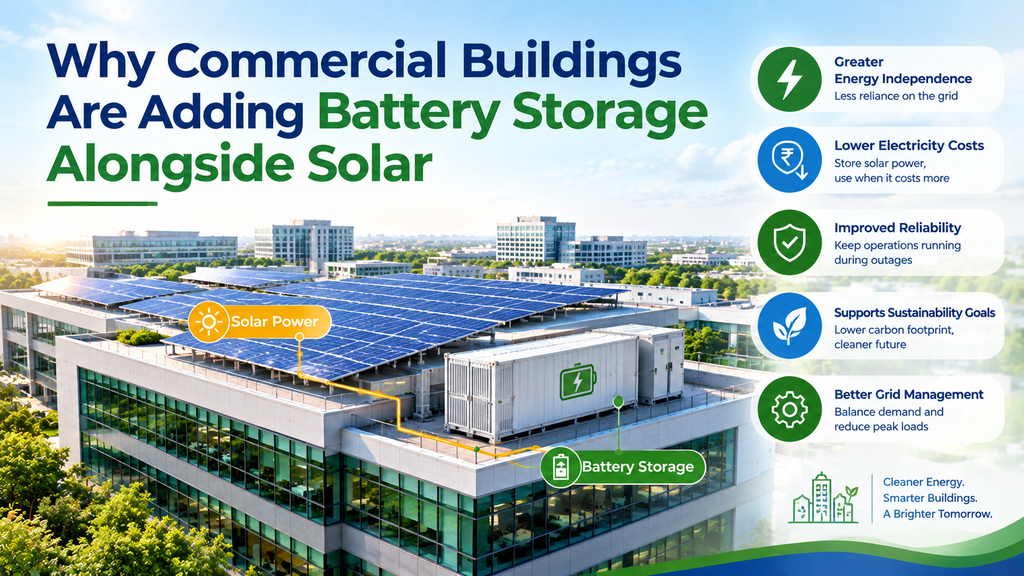
Rooftop solar on a commercial building is not unheard of anymore. Offices, malls, hotels and IT parks across Hyderabad and other Indian cities are now having panels as a standard way to cut daytime electricity cost. The second layer, lithium battery storage next to the inverter, is what has changed in 2026. Owners are now also asking whether solar belongs on the roof. They ask if the building should hold the midday generation for the evening peak, for backup, and for demand-charge control.
The short answer is solar still does most of the heavy lifting on cost. Storage affects how much of that generation the building actually uses at full retail value, and how the site performs when the grid goes down.
Quick Answer Box
Rooftop solar can be installed on commercial buildings. There is no cash subsidy of PM Surya Ghar for commercial connections. The primary tax benefit is 40 percent accelerated depreciation in year one. Solar-only systems reduce daytime electricity costs through self-consumption and net metering. Battery storage can store excess power produced mid-day for use in the evening peaks, reducing the run time of diesel generators and potentially reducing demand charges. In Telangana, commercial net metering is capped at 80 per cent of the sanctioned load and 500 kW. Where the evening load, number of outage hours or time-of-day peak charges are material, storage is justified.
Can Solar Panels Go on a Commercial Building?
Of course. Grid-tied, hybrid and, where required, off-grid systems are eligible for commercial and industrial rooftops. The relevant limits are structural capacity of the roof, sanctioned electrical load, DISCOM feasibility and the state net-metering cap. In Telangana, 2025 TERC rooftop regulation allows commercial and industrial consumers to install up to 80 percent of the sanctioned load under net metering with an upper limit of 500 kW for net-metering in total. There are bigger behind-the-meter arrays, but the interconnection and export rules become more restrictive above that level.
Practical starting conditions: A usable commercial roof, a three-phase hookup, and a clean title or landlord consent. Need to model the shadow from the neighbouring towers, water tanks and the HVAC plant before capacity is locked in.
Is Solar Subsidy Available for Commercial Projects?
PM Surya Ghar Muft Bijli Yojana is for domestic electricity connection only. No central cash subsidy up to ₹78,000 is given to commercial or industrial meters for shops, offices, hotels, warehouses and factories.
That doesn’t leave commercial owners out in the cold. Eligible companies can claim 40 per cent accelerated depreciation on the solar asset in the first year under the Income Tax Act. On a 50 lakh system that depreciation line can reduce taxable profit by 20 lakh in year one which at typical corporate tax rates is a larger rupee benefit than the residential subsidy cap. GST input credit may also be available where the output of the building is taxable.” Cash flow can be improved through state programs and concessional loans (e.g., SIDBI energy-efficiency lines for MSMEs). None of these are a replacement for a simple capital subsidy. None should be assumed to be certain without confirmation from the building’s tax advisor.
Why Commercial Buildings Are Adopting Solar in India
Commercial tariffs are still high vis-a-vis the levelised cost of rooftop solar. Daytime loads for office, retail and hospitality match solar generation. Tenants and corporate buyers are increasingly requesting on-site renewables in lease and ESG reporting. In Telangana, net metering still credits surplus, so a well-sized array will reduce the imported bill even if some energy is exported.
These are the reasons for solar. They do not explain batteries by themselves.
Why Storage Is Being Added to the Same Roof
A grid tied solar system without storage only generates power while the sun is on the modules. The building uses what it has at the time. Extras are exported. Anything needed after sunset is taken from the grid at full commercial tariff, or from a diesel generator during an outage.
Three commercial realities have driven owners into storage.
First, the value of exported units is not assumed to equal the value of imported units in each billing situation. Large surplus settlement can do well under retail tariff. Keeping more generation behind the meter protects the highest value use of each unit of generation.
Secondly, time-of-day structures are closing the gap between cheap midday power and expensive evening power. Telangana’s FY 2026-27 retail order introduced peak surcharge of ₹1.50 per unit at defined morning and evening times and off-peak rebate of ₹0.50 per unit at midday. A battery charged off solar between 10am and 6pm, and discharged after 6pm, takes the hit of that surcharge directly.
Third, commercial buildings lose money during power outages. Lifts, servers, lighting, HVAC controls and point of sale systems don’t wait. Diesel is reliable, but expensive, often costing ₹18–24 per unit, factoring in fuel, maintenance and runtime. A hybrid inverter with LFP battery can ride through short outages and reduce generator starts, avoiding DG replacement for long events.
Industry analyses of Indian C&I sites typically indicate self-consumption rising from around 60-65 percent on solar-only systems to 85-95 percent following the addition of a correctly sized battery. That difference is the basic reason to store financially.
How the Combined System Works in a Commercial Building
Hybrid inverter feeds the solar modules. During the day, the inverter first supplies the building. Extra charges the battery. If the battery is full, excess can still be exported up to the approved net-metering capacity. In the evening the inverter powers lighting, lifts and residual HVAC and then draws power from the grid. When the grid goes down, selected circuits are on battery for the designed autonomy (typically one to four hours for commercial backup) while non-essential loads may be shed.
The architecture is the same family of hybrid systems already used for homes and institutions, scaled to commercial busbars and with proper interlock so the solar-plus-battery plant does not backfeed a dead grid.
Table 1: Solar-Only versus Solar Plus Storage for a Commercial Building
| Factor | Solar only (grid-tied) | Solar plus LFP battery |
| Daytime bill cut | High if load matches generation | High, plus stored surplus used later |
| Evening / peak cost | Full grid tariff | Partial offset from stored solar |
| Outage behaviour | System shuts down (anti-islanding) | Selected loads continue for designed hours |
| Diesel runtime | Unchanged | Reduced for short and medium outages |
| Self-consumption | Often 60–70 percent | Often 85–95 percent when sized well |
| Extra capital | None beyond solar | Battery, hybrid inverter, extra protection |
| Typical payback | 3.5–5 years on well-matched solar | Longer than solar-only; tighter if diesel and ToD are high |
| Net-metering interaction | Export within cap | Charge first, export only surplus above storage |
The table is a planning view not a quote. Battery cost still adds a big line to the project in 2026. LFP pack prices have come down, but a commercial bank of 50-200 kWh is still a serious capital item. Thus storage is located in buildings where the evening demand, demand charges, or outage hours are high enough to justify that queue.
Sizing Storage without Overselling It
Battery size should be based on a measured load profile, not roof area. Useful inputs are interval data or at least month-wise bills plus simple weekday vs weekend split, the kW of loads that must stay on during an outage, and the number of hours those loads must run. Typical commercial pattern is two-to-four hours of autonomy on a defined critical bus, not whole building backup.
Oversizing the battery is wasted capital. Undersizing it doesn’t touch the evening peak and the first hour of an outage. The hybrid inverter rating must be compatible with the solar array and the backup bus. The roof structural report for the panels requires the same serious consideration for fire safety, ventilation and floor loading considerations as indoor or containerised BESS.
The Telangana practice also permits a building to take the full 500 kW net-metered solar slice and use any additional DC capacity only to charge batteries, provided export never exceeds the approved interconnection. Such design is attractive for sites with large roofs and strong evening load but it needs to be drawn and approved carefully so the DISCOM meter and the hybrid controller are within the sanctioned export limit.
Benefits of Solar Panels on Commercial Buildings, with and without Storage
The main benefits of solar for commercial buildings are bill reduction, long-term cost visibility and on-site generation that tenants can see. Panels on a commercial roof also support green-building and Scope 2 reporting. Storage does not substitute for those benefits. It focuses them.
Storage enables the building to hold more of its own generation and reduce exposure to peak windows, trim diesel hours and gain a defined backup interval. The project is simpler, cheaper and quicker to commission without storage, and is still worthwhile where there is a strong daytime load and a steady grid.
Neither config is inherently better. A fully occupied daytime office with rare outages may remain solar-only. A hotel, hospital-adjacent clinic, data-heavy office or retail site with evening occupancy and frequent change-over to DG has a clearer storage case.
Table 2: Generic Solar Pitch versus Storage-Aware Commercial Design
| Aspect | Generic pitch | Storage-aware design |
| Goal | Cut the monthly bill | Cut the bill and control when energy is used |
| System type | Standard grid-tie | Hybrid inverter, defined essential bus |
| Surplus treatment | Export and hope for full credit | Charge battery first, export the remainder |
| Outages | Not discussed | Designed autonomy in hours and kW |
| Tariff structure | Average ₹ per unit only | Day versus ToD peak versus demand charge |
| Subsidy story | Implied cash subsidy | Honest: no PM Surya Ghar; AD may apply |
| Battery size | “Add some storage” | Sized from load profile and backup list |
| Compliance | Net metering form only | Export limit, CEIG, fire and structural notes |
Owners wanting that second column don’t want to buy a battery that never cycles, or a solar array that dumps low-value export while the diesel set still starts each evening.
Commercial buildings with existing solar can add storage down the road if the existing inverter can be replaced or paralleled with a hybrid unit and if the electrical room can accommodate the battery footprint. That makes retrofit more expensive per kWh than a combined design from the start, which is why new commercial solar proposals in 2026 increasingly show both options with separate paybacks.
So, it’s less a case of rooftop solar and battery storage being a fashion statement, and more a reaction to the way commercial tariffs, export rules and outage costs now work. And the roof is still cheaper using solar. Storage is the way to get that energy into the hours when the building makes the most money.
People Also Ask
Is solar subsidy available for commercial?
Not under the PM Surya Ghar. This plan is applicable only to residential connections. Central cash subsidy of up to Rs 78,000 will not be available for commercial buildings. Eligible businesses can claim accelerated depreciation of 40 percent on the solar asset in the first year and should consult their tax advisor for GST input credit and any state or SIDBI finance lines.
What are the benefits of solar energy for commercial buildings?
On-site generation replaces grid units at commercial tariff and daytime electricity cost drops. Net metering allows for surplus to be credited within state limits. Energy cost is more predictable for 20+ years. On-site generation also enables tenants to report on ESG. The addition of storage increases self-consumption, decreases evening peak purchase and can reduce diesel run-time.
Why commercial buildings are adopting solar in India?
Commercial tariffs are high, roofs tend to be large and unused and daytime occupancy coincides well with solar output. “There’s more corporate demand and tenant demand for cleaner energy.” Well-matched rooftop systems often pay themselves back in 3.5-5 years before adding storage. Storage is the second-stage decision, driven by peak charges, export value and backup needs.
Benefits of solar panels on commercial buildings?
Panels take up unused roof space and turn it into generation that replaces the most expensive daytime units, reduce exposure to future tariff increases and need only limited operating staff once they are commissioned. Whether or not those benefits are reflected in the bill will be determined by structural analysis, shading analysis and proper electrical design.
Can I put solar panels on my commercial building?
Yes, subject to roof strength, sanctioned load, DISCOM feasibility and state net-metering caps. In Telangana commercial consumers may install up to 80 percent of sanctioned load under net metering, with a 500 kW ceiling. Landlord consent is required for leased premises. Hybrid systems with batteries are also permitted when designed and interconnected correctly.
Does a commercial solar system work during a power cut?
A standard grid-tied system shuts down during an outage for anti-islanding safety. It will not run lifts or servers while the grid is dead. A hybrid system with battery storage can keep a defined essential load running for the designed number of hours. Long outages still need the diesel generator.
How large a battery does a commercial building need?
Size follows the essential load in kW and the required autonomy in hours, plus any peak-shifting target. Many commercial sites start with two to four hours on selected circuits rather than whole-building backup. Interval load data produces a better answer than a rule of thumb based on solar kW alone.
Who designs commercial solar and hybrid storage systems in Telangana?
Samraj Solar, founded in 2014 by Abburi Ajay Kumar, is a specialised solar EPC company with its head office at H.No. 3-5-242/1, Krishna Nagar, Moula Ali, Hyderabad and branch office in Guntur. The company has executed projects for residential, commercial, industrial and institutional clients in Telangana and Andhra Pradesh. It is a licensed channel partner for Tata Power Solar for offering engineering, procurement and construction for grid-tie and hybrid systems including battery backed commercial rooftop projects and after-sales support.
Owners of commercial buildings that are considering solar-only versus solar-plus-storage can request a load-profile review that separates out daytime offset, evening peak and essential backup circuits. Bills, and a list of loads that are to stay on during an outage, and sanctioned load are enough to start that comparison.