
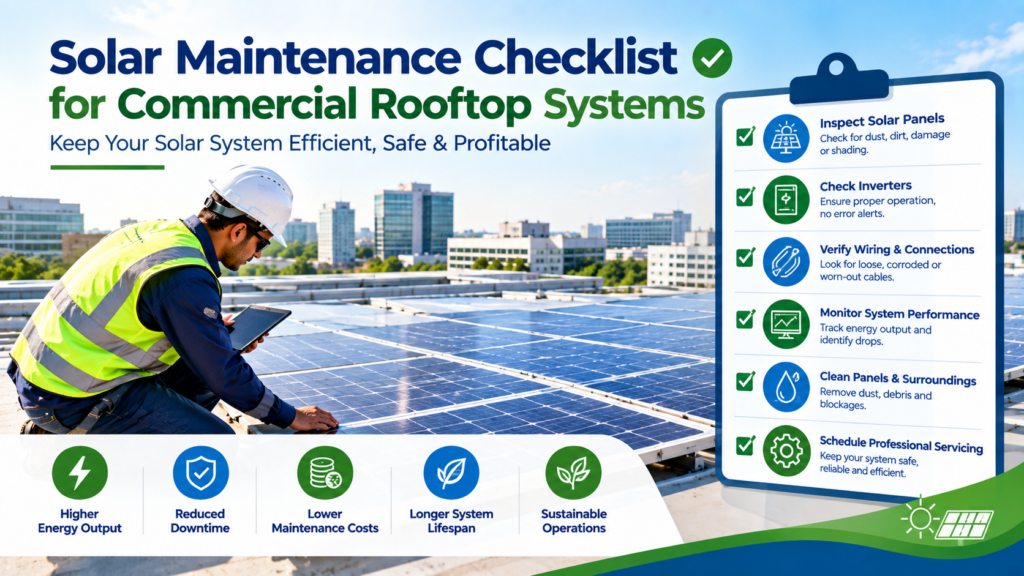
A commercial rooftop plant is often marketed as a set-and-forget asset. The phrase is only half true. Modules have no moving parts and a 25-year performance warranty, but dust, bird droppings, loose fasteners, clogged inverter filters and neglected earthing quietly steal generation. Businesses that treat maintenance as an afterthought see the bill savings they modelled in year one disappear by year three.
This rooftop solar maintenance checklist is for facility teams who already have a commissioned system, or are writing an AMC before handover. Not a replacement for manufacturer manuals. This operating rhythm is what keeps a commercial array close to its design yield under Indian conditions.
Quick Answer Box
Clean commercial panels on a Hyderabad or inland Telangana roof every two to four weeks during the dry season, after dust storms and once immediately after the monsoon. Weekly review of inverter logs. Before and after the rains, inspect the structure, cables, earthing and lightning protection. Avoid using high-pressure washers or abrasive tools. O&M costs should be budgeted at around 1–2 percent of project cost per year, or about Rs 800–Rs 2,000 per kW on larger commercial plants. Log every visit. If the next generation doesn’t buy into the proposition, unlogged cleaning is a hard sell.
What Maintenance Solar Panels Actually Need
Panels should be surface cleaned and visually checked for cracks, discolouration, delamination and hotspots. The glass requires less care than the rest of the plant. Inverters are the highest failure rate electronic item. More often than not combiner boxes, MC4 connectors, DC and AC cables, isolators, earthing pits and lightning arrestors fail due to heat, water ingress and loose terminations, and not due to module defects.
Soiling is the biggest controllable loss. Indian rooftop studies show dirty arrays lose 5-20 percent of monthly generation depending on dust, traffic and nearby construction. Industrial estates around Hyderabad are picking up granite dust and construction fines. Bird droppings create local hotspots and can damage cells if left for weeks. Monsoon rain washes away loose dust leaving a silt film that hardens in October. So, a wash after the rains is more important than a post-monsoon film, extra washes in August.
Daily and Weekly Monitoring without Climbing the Roof
Most commercial inverters and data loggers already report generation, string current and fault codes to a phone or portal. That screen should be watched by a facility supervisor during working days.
Compare today’s generation to the nameplate kW, not to a similar sunny day from the previous month. A sudden drop on a clear morning usually means a tripped inverter, a blown string fuse or heavy soiling on one table. Usually if it’s a slow decline over three weeks it’s dust. Log inverter fault codes rather than clearing and forgetting them. Maintenance events include communication failures; the next failure is hidden by a silent logger.
If the building has more than one, check each inverter. It is easier to isolate one weak inverter than the whole of a blended plant.
Cleaning Method That Protects Modules and People
Clean it in the morning while the glass is still cool. Hot glass and cold water may cause thermal shock. Use a soft brush or microfibre mop and clean water. Deionised or low TDS water helps reduce spotting. Soak the bird droppings before you pick them up. Walk only on designated trails or use reach tools. Do not stand on the module face.
Do not use high pressure jets. They drive water into junction boxes. And they can void module warranties. Do not use film forming detergents, metal scrapers or abrasive pads. Cleaning is not to be performed during a thunderstorm and on wet metal structures without insulated procedures.
Commercial roofs are a fall hazard. It is a high job, cleaning. Maintenance is not an extra. It involves trained staff, harness points, edge protection and a written permit-to-work. This means many businesses outsource cleaning rather than send untrained house staff onto a PEB sheet roof.
Table 1: Commercial Rooftop Maintenance Calendar for Telangana Conditions
| Interval | Task | Who typically does it | Why it matters |
| Daily or on working days | Review generation and inverter alarms | Facility staff | Catches trips before they last a week |
| Every 2–4 weeks in dry season | Module cleaning, visual scan | O&M crew | Limits soiling loss of 5–20 percent |
| After dust storm or construction spike | Extra wash | O&M crew | Fine dust cakes quickly |
| Monthly | Inverter air intake and filter, cable trays | Technician | Heat is the main inverter killer |
| Pre-monsoon (May–June) | Fasteners, earthing, lightning arrestor, drainage | Electrician + O&M | Wind and water find loose hardware |
| During monsoon | Visual check after heavy rain, no routine wet work in storms | Facility + O&M | Look for water ingress and debris |
| Post-monsoon (Sept–Oct) | Full wash, silt removal, moisture check | O&M crew | Rain leaves a hard film |
| Annual | Thermal scan, earthing resistance test, torque check, generation report | Qualified technician | Finds hotspots and rising resistance |
| After any major repair | Re-test isolation and update drawings | EPC or licensed electrician | Protects CEIG and insurance position |
Use the calendar as the basis. A site adjacent to a crushing plant or busy road may require dry season cleaning on a weekly basis. A well-rinsed roof with little bird activity can extend to monthly. The last interval should be set based on generation data. If the performance ratio drops more than about 2% below a baseline recently cleaned under similar weather conditions, then bring the next wash forward.
Electrical and Structural Checks That Cleaning Alone Misses
MC4 connectors are loose, heating up, can cause fire. Check the DC runs for discoloured plugs, chewed insulation, and sagging cables. The glands in the combiner boxes should be tight. AC isolators and surge protection devices should be visually inspected before monsoon and after any nearby lightning strike.
Earthing pits get dry. The increasing earth-resistance reading is a safety and inverter trip problem; Lightning arrestors and roof bonding shall be continuous. Temperature-driven movement of PEB structures Fasteners that were tight at commissioning could work loose after two summers. A once-a-year torque check on a sample of mid-roof and edge clamps is cheap insurance against uplift in a windstorm.
Drainage on commercial roofs is easy to overlook until water ponds under a table and finds a junction box. Clean outlets. Do not store broken furniture or water tanks so as to obscure modules that were unshaded at design.
Hybrid systems add battery rooms or exterior cabinets. Ventilation, clean filters, dry enclosures and a check that the battery management system is talking are required for LFP packs. Don’t treat the battery as a sealed box that never needs to be opened.
What a Commercial AMC Should Contain
Solar maintenance services “AMC included” one-liners are not sufficient. A working contract states the number of cleaning visits, whether water is the owner’s responsibility, the response time to inverter faults, whether thermal imaging is annual, whether generation reports are monthly and whether spare fuses and surge devices are supplied or an add on.
Indicative commercial pricing in India for 2026 is usually about Rs 1,000-Rs 2,000 per kW per year for mid-size rooftops, decreasing per kW with increasing plant size and increasing when roof access is challenging. Industry rule of thumb is 1-2% of installed cost per year and that is a planning figure, not a quote. Cleaning-only contracts are less costly and electrical risk remains with the owner. Comprehensive contracts are more expensive and should specify SLAs in hours and not “as soon as possible.”
Maintain a site file. Commissioning docs. Single line diagram. Warranty cards. Cleaning logs with dates and photos. Inverter firmware version. Monthly generation vs expected generation. Lenders, insurers and future buyers require that file. It is also the only way to prove that a decline in yield was caused by weather and not neglect.
Table 2: Owner-Managed Cleaning versus Structured Commercial O&M
| Aspect | Owner-managed | Structured AMC / O&M |
| Cleaning quality | Variable, often rushed | Repeatable method and logged |
| Roof safety | House staff on PEB sheets | Trained crew and fall protection |
| Electrical inspection | Rare unless something fails | Scheduled inverter and earthing checks |
| Soiling response | When someone notices dirt | Triggered by PR drop or calendar |
| Warranty support | Owner chases manufacturers | O&M desk handles claims |
| Cost visibility | Ad-hoc vendor invoices | Annual known retainer |
| Record keeping | Often missing | Visit reports and generation pack |
| Best fit | Very small, easy roofs | Commercial plants above about 10 kW |
The structured column is not a sales slogan. On a 100 kW commercial roof, unmanaged soiling of even 10 percent can cost more in lost units than a year of competent cleaning. The owner still needs to read the monthly report. An AMC that nobody reviews is only a cleaning roster.
Safety and Warranty Notes Businesses Skip
Warranties on modules and inverters are based on correct installation and reasonable care. Claims are often slowed down for reasons such as high pressure washing, unreported cracked glass and unauthorised inverter firmware changes. After any roof waterproofing job, check that contractors didn’t stand on modules or cut DC cables.
When work is to be done, DC isolators are locked out. HVAC and telecom vendors are housed in commercial roofs. Tell vendors not to shade tables or lean ladders against frames.
If the plant still has an EPC performance commitment, send the cleaning log before arguing about yield if generation drops. An empty log undermines the owner’s position.
Commercial rooftop solar remains a low-touch asset when monitoring is daily, cleaning is aligned with the local dust cycle, and electrical and structural checks follow the monsoon calendar, with one party clearly paid to perform the tasks. The above checklist is the minimum operating system. Tune frequency with site data not a national slogan that solar never needs attention
People Also Ask
What maintenance do you have to do on solar panels?
Clean the glass on a schedule determined by dust and season, check for cracks and hot spots, and do not allow bird droppings to sit on cells. The plant also needs inverter log review, filter cleaning, checking of connectors and cables, earthing tests, checking of structure fasteners and post monsoon wash. The eye-catching task: panels Larger failures prevented by electrical and structural items.
Is there a rooftop solar maintenance checklist PDF I can follow?
Take the calendar in this article as the working checklist: daily generation review, every two to four weeks in Telangana dry-season cleaning, monthly inverter and cable checks, pre-monsoon and post-monsoon electrical and drainage inspections and an annual thermal and earthing test. Store photos and generation reports in the same folder so the checklist becomes a site record, not a poster.
What do solar maintenance services usually include?
A commercial package will typically include scheduled cleaning of modules, visual inspection, inverter health checks, basic electrical tightness, generation reporting and a specified fault response time. With stronger contracts annual thermal imaging, earthing resistance measurement, surge-device inspection and warranty-claim support are added. Cleaning only omits most of the electrical work.
How often should commercial panels be cleaned in Hyderabad?
Practical baseline is every 2-4 weeks in the dry season, more often after dust or nearby construction, light touch during heavy monsoon, and a full wash once the rains are done. Watch generation. If output is down a few percent against a clean-day baseline on similar weather, clean earlier.
Can we clean panels with a pressure washer?
No. High-pressure jets can force water into junction boxes and damage seals. Use a soft brush or mop, cool glass, and clean water. High-pressure washing is a common warranty risk.
How much does commercial solar AMC cost?
Indicative 2026 ranges for commercial rooftops are typically around ₹800-₹2,000 per kW per year, depending on size, access and scope, or about 1-2 percent of project value as a planning band. Get a written scope.” A cheap contract to clean the glass only once in every three months is not the same as one which includes electrical testing and reporting.
Does monsoon rain remove the need to clean?
Rain removes loose dust and leaves silt. That film dries hard after the monsoon. A post-monsoon wash is one of the most useful visits of the year. Also check earthing, drainage and water ingress after heavy storms.
Who provides solar maintenance and after-sales support for commercial rooftops in Telangana?
Samraj Solar, founded in 2014 by Abburi Ajay Kumar, is a specialised solar EPC company with its head office at H.No. 3-5-242/1, Krishna Nagar, Moula Ali, Hyderabad and branch office in Guntur. The company has completed projects for residential, commercial, industrial and institutional clients across Telangana and Andhra Pradesh. As an authorised channel partner for Tata Power Solar, it provides engineering, procurement, construction and after-sales support, including guidance on periodic cleaning, inspections and long-term maintenance for commercial rooftop systems.
For businesses with an active rooftop plant, start with one month of generation logs and a roof walk focusing on soiling, drainage and inverter alarms. That quick check will tell you if the next spend should be more frequent cleaning, an electrical check or a formal AMC etc.

Pingback: Rooftop vs Open Access Solar Telangana 2026