
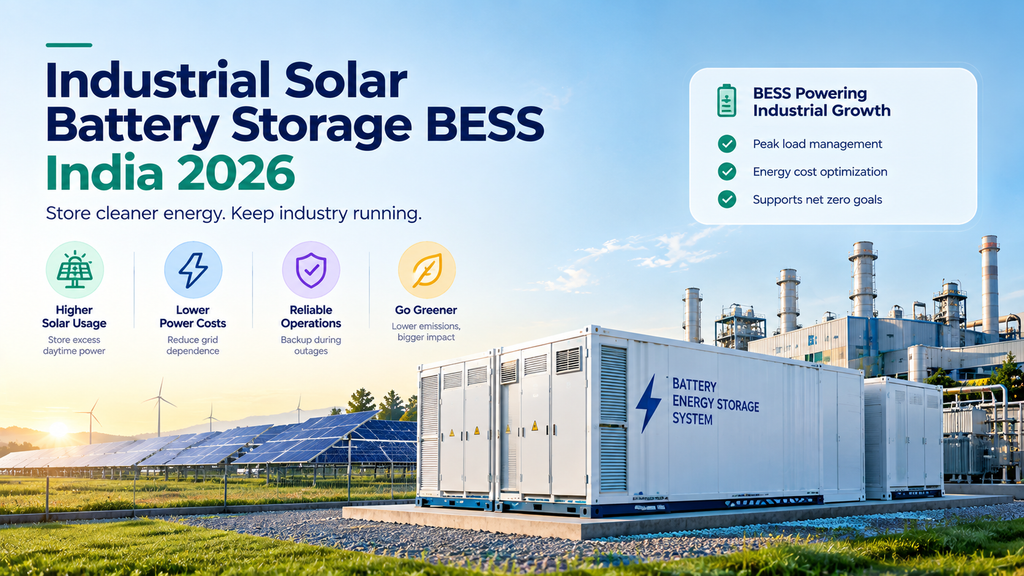
A firm with rooftop solar still buys evening power at full HT rate and still fires up a diesel engine when feeder lowers. That’s when industrial batteries come in. The question for 2026 is not if lithium storage works. It is a question of whether the extra capital earns its way on your load profile.
For some plants, the answer is yes, already. Solar-only is the cleaner spreadsheet for single-shift units with infrequent outages and a roof that matches daylight consumption.
Quick Answer Box
BESS is worthy of modelling if you use diesel more than a few hours a week, for the peak of ₹1.50 per unit in Telangana ToD fee, or export rooftop units at a weaker credit than you pay to import after dark. Expect storage to add a big amount to project cost and to stretch simple payback vs solar only, unless fuel and peak charges are high. Telangana does not have a statewide industrial storage requirement in 2026. Two to four hours in size on the loads that really move the money.
What BESS Is on a Factory Floor
BESS stands for Battery Energy Storage System. In industrial rooftop work it’s commonly an LFP (lithium iron phosphate) pack, a battery management system, a power conversion system or hybrid inverter and a controller that selects when to charge from solar and when to discharge into the plant bus.
During the day the solar array feeds machinery first. Surplus charges the battery prior to or instead of export. The inverter pulls from the pack when the sun goes down or during the ToD peak window. If the grid fails, the specified circuits stay on batteries for the designed amount of hours. The diesel set is for extended events. The battery is not a 24-hour power station unless you pay for it to be.
Round-trip efficiency on a fully designed LFP system is usually in the high eighties percent level. You don’t receive all your units returned. That loss has to be in the payback model.
Why Industry Is Asking Now
Three numbers turned the discourse.
First, prices for cells and packs fell sufficiently that C&I storage was no longer only a showpiece item. Installed industrial costs still vary greatly by size and enclosure, but the trend spanning 2024–2026 made two-hour factory systems discussable.
Secondly, the economics of solar-only hit a ceiling. Telangana commercial and industrial net metering is limited to 80 percent of sanctioned load and 500 kW. The extra midday power that cannot be stored or used has less value than a unit used on the evening line. For Indian C&I locations, self-consumption tests frequently show solar-only to be about 60–65 percent, and 85–95 percent with an appropriately sized battery.
Third, diesel did not become cheaper. All-in DG units, when you add in fuel, goods, maintenance and wet-stacking, remain in the 18–24 range.” A battery powered from captive solar replaces those units at a significantly lower marginal cost and switches in milliseconds instead of seconds.
Telangana’s FY 2026–27 retail order retained a peak surcharge of ₹1.50/unit during the 6–10 a.m. and 6–10 p.m. periods and ₹0.50 rebate from 10 a.m. to 6 p.m. Before demand-charge effects, a pack that is charged in the rebate window and emptied in the surcharge window earns that spread on every shifted unit.
The state also sanctioned utility-scale BESS at Maheshwaram and Choutuppal. That’s the grid infrastructure. It doesn’t instantly put a container on your shop floor. Factory BESS still has private investment.
When BESS Is Worth the Investment
Score the plant on four levers. Usually two or more strong levers justify thorough design. Zero or one usually implies wait or install a hybrid inverter and add packs later
Diesel hours. Run DG real for 90 days runtime. The largest single line is generally fuel if the set covers nightly peak loads or weekly feeder fault loads avoided.
ToD peak buy. Pull interval or ToD-split bills. If a meaningful share of units falls in the ₹1.50 surcharge window, storage has a tariff job, not a backup job.
Demand charges. HT bills are kVA or kW consumption. A battery that clips a small spike can cut the adjacent month setting peak contract. This lever is special to the place. Number of brochure is not assumed.
Solar trapped. If the roof can hold more modules to charge a pack then any additional DC beyond the daytime load + export cap is worth something. That is the approach already mentioned for Telangana sites taking 500 kW of net-metered export and extra solar merely behind the meter.
Is BESS worth the investment is therefore not a national slogan. A cold store with night compressors and weak feeders will score differently from a day-only fabrication shed with a stiff 33 kV supply.
What It Costs and How Payback Behaves
Even when load equals generation, straightforward paybacks of 3.5-5 years are still common on only solar commercial rooftops in the region. Adding storage lengthens that unless the savings are considerable.
The published C&I screening bands for India in 2026 are clustered roughly as follows. Peak shaving only: around 6 to 8 years. Peak shaving + ToD shift : ~5-7 years. Plus solar self-consumption: around 4–6 years. Those plus substantial diesel displacement, perhaps 3-5 years. A wait. Weak sites with none of the following can languish for upwards of 9 years.
In some of the C&I write-ups, storage can contribute about Rs 2-2.5 per unit on a levelised basis above solo solar. decreases with larger pack.₹ per kWh installed Small 100-500 kWh commercial cabinets are more expensive per kWh than multi-MWh containers. Treat every public table like a screen. Get a site estimate.
Battery life is not 25 years. LFP industrial packs are typically warranted for 10-15 years or a cycle warranty (sometimes several thousand cycles). The initial battery will be outlived by the solar modules. Plan a replacement or augmentation in the second decade.
Qualifying plant including storage acquired as part of the energy asset may be eligible for accelerated depreciation under the Income Tax Act. Check with the company’s tax adviser. PM Surya Ghar cash subsidy on industrial meters still not there
Table 1: Solar-Only versus Solar plus Industrial BESS
| Factor | Solar only | Solar plus LFP BESS |
| Daytime HT units | Strong offset | Strong offset |
| Evening / ToD peak | Full grid or diesel | Partial shift from stored solar |
| Self-consumption | Often ~60–70 percent | Often ~85–95 percent if sized well |
| Outage on essential bus | Array shuts down | Designed hours of ride-through |
| Diesel runtime | Unchanged | Cut for short and medium events |
| Extra capex | None | Pack, PCS or hybrid inverter, fire and civil |
| Simple payback | Typically shorter | Longer unless diesel or ToD is heavy |
| Telangana export cap | Binds noon surplus | Surplus can charge the pack first |
The table is a planning view. A two-hour pack will not erase an eight-hour night shift. A four-hour pack on a 200 kW essential bus is a different project from “backup the whole factory.”
How to Size without Buying a Warehouse of Cells
Start with interval data, or at least workday vs Sunday load, and a ToD split. List kW that must remain on during an outage and for how many hours Enter kW of nighttime peak you want to clip. Roughly power x hours, then enhanced for depth of discharge and efficiency. This is the battery energy in kWh.
The initial industrial projects typically come in at two to four hours. That’s the ToD evening block and a typical feeder dip summarised. It is not an option, a diesel farm for 12 hours.
Inverters must be hybrid, or AC-coupled with a listed PCS. A normal grid-tie inverter cannot establish a backup bus. Uncertain factories can choose hybrid inverters on the solar plant now, and land packs when the bill data is clearer. Vendors in Telangana have already taken that route.
Civil and safety are included in the investment.” Outdoor containers need clearances, fire access and manufacturers’ ventilation requirements. Indoor needs detection, suppression tactics and trained access. The new source must be shown on CEIG and factory electrical drawings. Not doing that effort is how a “cheap battery” becomes an uninsurable box.
Table 2: Strong Business Case versus Weak Business Case
| Signal | Strong case | Weak case |
| DG hours | Weekly or daily evening use | Rare, well-fed 33 kV or 132 kV |
| ToD peak share | Large evening or morning block | Almost all use in solar hours |
| Roof versus load | Surplus noon power hitting the cap | Roof already smaller than day load |
| Demand spikes | Short peaks that set kVA charges | Flat load, demand already optimised |
| Process risk | Outage stops a line or a cold chain | Outage is only lights and fans |
| Finance view | 5–7 year hurdle acceptable | Must beat 3-year solar-only payback |
| Mandate | Operating in a state that requires storage | Telangana: no C&I rooftop storage mandate |
Maharashtra’s 2026 requirement that new grid-interactive solar above 100 kW must store half its capacity for two hours does not apply to a Hyderabad firm. Don’t let a capex from another state dictate your sales deck. Let the same physics determine your sizing: A two-hour nighttime shift is the standard industrial starter package.
Risks That Make “Wait” the Right Word
If the sole pitch is “energy independence,” the pack is likely large. The quote has no cycle warranty and no fire standard and no response SLA and the capex is not complete. If controller does not stop export over allowed net metering limit, DISCOM trouble will follow If finance compares BESS payback to solar only payback and says no to anything over four years, buy the solar now and leave room for the container.
Solar + battery storage for industries is a stacked-value asset. It pays when avoided diesel, avoided peak tariff, avoided demand spikes and rescued solar units add up to more than the carrying cost of the pack. In 2026 that sum works for a growing set of Indian factories. It still does not work for every shed with a sunny roof.
People Also Ask
What is BESS in solar?
BESS is a Battery Energy Storage System paired with a solar plant. It stores surplus daytime generation in an LFP pack and discharges that energy into factory loads during peaks, evenings or outages. It needs a hybrid inverter or a separate power conversion system.
Is BESS worth the investment for a factory in 2026?
It is worth it when diesel hours, ToD peak units or trapped solar export are material. Screening paybacks often fall in the 5–8 year band, shorter if diesel displacement is large, longer if the site is day-shift only with a firm grid. It is not automatic.
How much does industrial battery storage cost?
Cost per kWh falls with size. Small commercial cabinets sit higher; multi-MWh containers sit lower. Public 2026 ranges vary widely. Demand an installed figure that includes PCS, civil, fire and integration, not only the cell price.
Can BESS replace a diesel generator?
For short and medium outages on a defined bus, often yes. For multi-hour site-wide blackouts, keep the DG. The usual industrial result is fewer DG hours, not a missing chimney.
Does Telangana require batteries on industrial solar?
No statewide mandate like Maharashtra’s April 2026 rule for new projects above 100 kW applies here. Storage is a commercial choice. Net metering remains 80 percent of C&I load and 500 kW.
How long should an industrial battery last?
Plan on about 10–15 years or the cycle warranty, whichever binds first. Modules last longer. Include augmentation in the second decade of the plant.
Will a battery work during a grid failure?
Only if the system is hybrid or islanding-capable and the loads are on the backup bus. A normal grid-tie inverter shuts down in an outage.
Who designs industrial solar and hybrid storage in Telangana?
Samraj Solar, founded in 2014 by Abburi Ajay Kumar, is a specialised solar EPC firm with its head office at H.No. 3-5-242/1, Krishna Nagar, Moula Ali, Hyderabad and branch office in Guntur. The company has done projects for residential, commercial, industrial and institutional clients across Telangana and Andhra Pradesh. It is an authorised channel partner for Tata Power Solar. They provide EPC for grid-tie and hybrid systems including industrial rooftop plants that can be configured for future battery addition.
Factories can begin with 90 days of DG-hour logs, a ToD-split bill and a list of circuits that must survive a feeder dip. That pack tells you if a 2 hour BESS is a finance project or a brochure.