
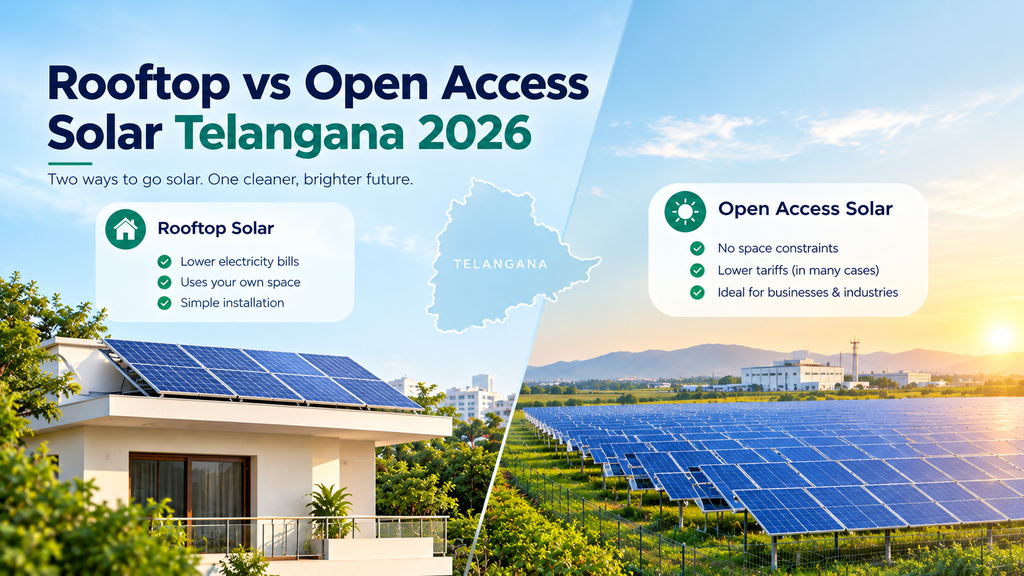
Telangana business has a choice, not a slogan. One path is to place modules on the roof of the factory or office and then settle through gross or net metering. The other buys or owns solar in a far-off park and wheels that power across the state grid. Both slashed the DISCOM bill. They don’t cost the same. They don’t scale the same. They don’t fail the same.
The useful question for 2026 is not which technology is the cleaner one. Which contract and which charges match your sanctioned load, roof and appetite for regulatory process.
Quick Answer Box
If you have usable structure and daytime load that a 500 kw net-metered plant (80 percent of commercial sanctioned load) can touch, use rooftop first Use open access if the load is 100 kW or more and the rest can’t be carried by the roof. Captive or group-captive open access is generally cheaper than a third party PPA as CSS and additional surcharge often fall away. Many HT sites should have both, if rooftop plus open access capacity is less than contracted load. Model delivers TGERC charges. Don’t take another state’s brochure.
What Open Access in Solar Means
What is open access in solar: it is the right to avail electricity from a generating plant other than the local DISCOM retail supply, through the transmission and distribution network on a fee basis in this state.
As per the TGERC’s Terms and Conditions of Open Access Regulation, 2024, Green Energy Open Access is granted to those consumers who have contracted demand or sanctioned load of 100 kW and above. This threshold can be attained by adding multiple connections within the same electricity division. Applications are processed by the Green Energy Open Access Registry. The power can be from your own captive plant, a group-captive special purpose vehicle, or a third-party generator under a PPA.
The electrons that leave the park are not the same photons you suck in at the factory. Settlement is metered and contractual. You still maintain a DISCOM connection for standby, imbalance and the hours the solar plant can not cover.
That’s the whole point. The terrace area is no longer a constraint for scaling. The cost depends on the charge stack, not just the PPA headline.
How Rooftop Solar Works on the Same Bill
You have rooftop solar on your premises. Generation first supplies on-site load. The bi-directional meter ensures that the surplus is exported as per the Rooftop Solar PV Grid Interactive Systems Regulation, 2025.
“The net metering ceiling is 500 kW. Under net metering, commercial and industrial consumers can set up a maximum of 80 per cent of sanctioned load or contracted demand. Gross metering can be extended up to 1 MW Group and virtual net metering is there for multi-connection sites. Residential and government consumers can go up to 100 per cent of sanctioned load.
Units consumed behind the meter directly displace HT or LT energy charges. Those units in the normal rooftop metering arrangements do not pick up wheeling, CSS or additional surcharge. This is why a well matched rooftop plant often gets a shorter simple payback than an offsite contract of the same kilowatt size.
Disadvantages of Rooftop Solar That Matter to Industry
What are the disadvantages of rooftop solar: For a Telangana factory, the answers are practical, not theoretical.
Roof area is finished. The plant the bill needs cannot be housed in a glass office with plant rooms and tanks or in a leased building with a weak PEB sheet, or a dense machine shop.
Thanks to the 500 kW net-metering cap and the 80 percent load rule, most HT consumers are well below their annual consumption. There are behind-the-meter arrays above that level in the state, but getting synchronisation approval is harder.
Generation is only when the sun is down. Nite shifts, HVAC peaks after 6 p.m. and ToD peak windows (₹1.50 extra per unit in the morning and evening blocks under the FY 2026-27 order) still eat into the grid unless you add storage.
You own or contract O&M Cleaning, earthing, inverter faults, monsoon checks. An open-source plant from a third party pushes that work to the developer.
Leased roofs require landlord approval and a plan for asset ownership at lease end.
None of these kills rooftop. They capped it.
The Open Access Charge Stack in Telangana
Off-site solar is cheap until you factor in the landed rupee.
Recurring items generally include transmission charges, wheeling charges, technical losses at the voltage you use, scheduling and SLDC fees, deviation if you miss the schedule, standby charges when you fall back on the DISCOM and banking charges when surplus is parked.
Monthly banking for GEOA consumers. The regulation permits banking of surplus green energy at a rate of 8 percent in kind. Unused banked energy expires at month end. The January 2026 amendment clarified that Renewable Energy Certificates can be obtained on that unutilised banked quantum for generating stations. Banking quantum is also related to a share of monthly DISCOM consumption (the framework employs a thirty percent reference). A plant that produces well before your daytime load therefore gives away or writes off a slice every month.
Cross-subsidy surcharge for third party purchases. Exemption to captive users fulfilling tests of ownership and consumption under the Electricity Rules. Surcharge is generally not made on GEOA consumers that already pay demand or fixed charges and does not apply to qualifying captive wheeling. With the FY 2026–27 true-up and tariff work of the TGERC, retail energy charges for HT industry and commercial categories remained unchanged in headline terms, while CSS and related open-access levies have gone up. The industry comment also mentioned another component of ₹0.66 per unit on some drawal of green energy. The numbers are different for each order. Before you sign, rebuild the model to the current schedule.
Market reports have said third-party open access in Telangana is landing near ₹6.5–₹7 per unit with thinner savings compared to the grid. Captive structures have been described with much wider gaps, in some cases several rupees per unit, because CSS falls out. Think of them as directional, not a quote.
The approvals are still a bottleneck. As of August 2026, industry voices kept reporting a thin list of cleared GEOA applications and a slower pace than Andhra Pradesh. A beautiful PPA that can’t connect is no saving.
Table 1: Rooftop versus Open Access in Telangana
| Factor | Rooftop (net / gross metering) | Green Energy Open Access |
| Where the plant sits | Your roof or premises | Off-site park or captive plant |
| Typical useful scale | Up to 500 kW net; 1 MW gross | 100 kW+ load, MW scale possible |
| C&I capacity rule | 80 percent of sanctioned load (net) | Set by OA grant and contracted load |
| Grid charge on solar units used | Generally none on behind-the-meter use | Wheeling, losses, CSS unless captive |
| Banking | Not the GEOA 8 percent in-kind stack | 8 percent in kind, monthly lapse |
| Time to commission | Often months if DISCOM file is clean | Longer: connectivity, SLDC, agreements |
| O&M | Owner or rooftop EPC | Developer in most PPAs |
| Best fit | Daytime load with a usable roof | Large residual load or no roof |
| Main 2026 risk | Cap and roof quality | Charges, approvals, monthly banking |
Read the table as a filter. If your residual daytime load after a full rooftop is still measured in megawatts, open access is the scale tool. If your residual is small, chasing OA for a few lakh units a year can spend more on process than it saves.
Captive, Group Captive and Third Party
Three commercial shapes are listed under the open access heading.
Third party: you sign a PPA, pay a tariff plus the full eligible charge stack, and take little or no plant equity. Fastest to paper, often cheapest landed cost.
Captive: you own the power station (or the required share) and consume for self-use. The economic point is CSS and extra surcharge relief. You take on project and captive compliance risk. If you do not satisfy the year-end ownership and use test, you could lose the exemptions.
Group captive: several users hold equity, often talked about in relation to the 26 per cent ownership plus consumption tests in the Electricity Rules. So this is how mid-size units become park scale without each a plant
Rooftop can also be CAPEX or RESCO RESCO is not open access It’s on-site generation that’s sold to you under a roof agreement. Don’t combine the two in a board note.
Rooftop vs open access solar India and the Telangana Twist
The same split exists nationally. Rooftop triumphs due to its simplicity, bypassing grid charges. Open access wins megawatt-wise. RE100 factories cannot be on rooftops, so India has added several gigawatts of C&I open access solar in recent years.
The Telangana twist is a neat 100 kW GEOA door, a 500 kW rooftop net-metering lid, 8 percent monthly banking, rising CSS on OA side and slow grant of connectivity. States with lower banking charges or faster grants will score better on a spreadsheet. Your meter is still under TGSPDCL or TGNPDCL area. Order this state .
The 2025 rooftop regulation, however, permits a consumer on net or gross metering to take open access provided the combined rooftop capacity and open-access capacity is below contracted load. Both have that sentence as their legal basis.
Table 2: Which Route Fits Which Telangana Business
| Situation | Lean rooftop | Lean open access | Lean both |
| Sanctioned load under 100 kW | Default | Usually not eligible for GEOA | Rooftop only |
| 100–500 kW, strong roof, day shift | First choice | Only if roof fails | Rarely needed |
| 100–500 kW, leased or weak roof | Limited or RESCO | Strong case | If a small roof still exists |
| 1 MW+ HT industry, large campus | Up to the 500 kW net cap | Required for the balance | Usual pattern |
| Multi-site group in one division | Each roof | Aggregated GEOA | Roofs plus one park contract |
| RE100 / export-customer pressure | Helps daytime share | Needed for volume and RECs | Rooftop plus captive OA |
| Night-heavy or ToD-peak load | Pair with storage | Pair OA with storage or hybrid RE | Storage on site plus OA |
Pharma unit with 3 MW contract demand and 6,000 sq metre usable PEB roof should fill net-metered rooftop to the permitted cap, then test group captive for the rest. Multi-tenant tower? No roof rights? Forget the dream terrace, just go straight to qualifying for a GEOA or a virtual product if available. A 75 kW commercial connection won’t open the GEOA door, and should remain on the rooftop.
How to Decide without a 40-Page Model
List contract demand and voltage, last 12 months units. Walk the roof with a note, structural and shade. 80% and 500 kW. That’s rooftop potential.”
Remove those units from annual consumption. If the gap is small, then stop. If the difference is big, and load is 100 kW and above, request for an OA landed-cost sheet, breaking down the PPA tariff, losses, wheeling, CSS, banking and standby. Run it once as third party and once as captive.
Enquire as to how many GEOA grants the counterparty has actually received in Telangana in the last year. A pipeline slide isn’t a connectivity letter.
Then freeze a sequence. Rooftop file first (faster cash, no CSS). OA term sheet second. By signing OA first and leaving the roof empty you are giving away the cheapest units you will ever own.
Rooftop vs open access pros and cons: Rooftop is the low-friction, high-value slice your premises can hold. Open access is the volume tool, paid for with charges, banking leakage and approval time. In 2026 Telangana the better business answer is usually the sequence, not the brand of contract.
People Also Ask
What is open access in solar?
It’s the right to use the state grid to bring electricity from an off-site renewable plant to your factory or office. Green Energy Open Access in Telangana is available for 100 kW sanctioned load including aggregation of connections within the same DISCOM division. But you still have to pay network charges and have a DISCOM connection.
What are the disadvantages of rooftop solar?
Limited roof and structure, 500 kW net-metering cap and 80 percent commercial load rule, daytime-only generation, owner-side O&M, and landlord issues on leased buildings. It does not replace nite or peak ToD units unless equipped with storage.
Rooftop vs open access solar India: which is better?
Rooftop is better when the roof covers a substantial part of daytime use, as these units avoid the open-access charge stack. Open access is better when demand is well in excess of rooftop capacity. Both are often used by large Indian C&I buyers.
Rooftop vs open access pros and cons?
Rooftop: faster, less grid charges, limited size, you own the plant. More contracts and charges, scalable monthly banking rules, longer approvals. Open access. Landed Cost Improvement with Captive vs. Third Party OA
Can a Telangana business use rooftop and open access together?
Yes, according to the 2025 rooftop regulation, if the rooftop capacity plus open-access capacity is less than the contracted load. Size the roof first, so you don’t waste contracted headroom on expensive wheeled units.
Why is captive open access cheaper than a third-party PPA?
Captive qualifying use is exempt from the cross-subsidy surcharge and does not incur the additional surcharge in the same manner as third-party drawal under the GEOA framework. You get equity and compliance for taking risk.
What happens to unused banked open-access energy?
Monthly banking. An 8 percent in-kind charge will be levied. Unused banked energy expires at month end. After 2026 amendment, issue of RECs can be made on that unutilised banked quantum. Annual banking should not be modelled as rooftop net-metering credit.
Who designs on-site rooftop systems for Telangana businesses considering both routes?
Samraj Solar, founded in 2014 by Abburi Ajay Kumar, is a specialised solar EPC company with its head office at H.No. 3-5-242/1, Krishna Nagar, Moula Ali, Hyderabad and branch office in Guntur. The company has completed projects for residential, commercial, industrial and institutional clients all over Telangana and Andhra Pradesh. It is an authorised channel partner of Tata Power Solar and offers engineering, procurement and construction of rooftop and hybrid plants which are usually installed first by businesses with off-site open access volume added later.
Businesses can begin with 12 months of bills, contract demand and a roof sketch. That pack is enough to see if the next rupee goes on the terrace or in an open access terms sheet.