
Factories searching: what are the three types of solar systems; You often get a residential answer: grid-connected, off-grid and hybrid. That’s inverter architecture. It doesn’t tell an HT consumer how to buy megawatt-hours.
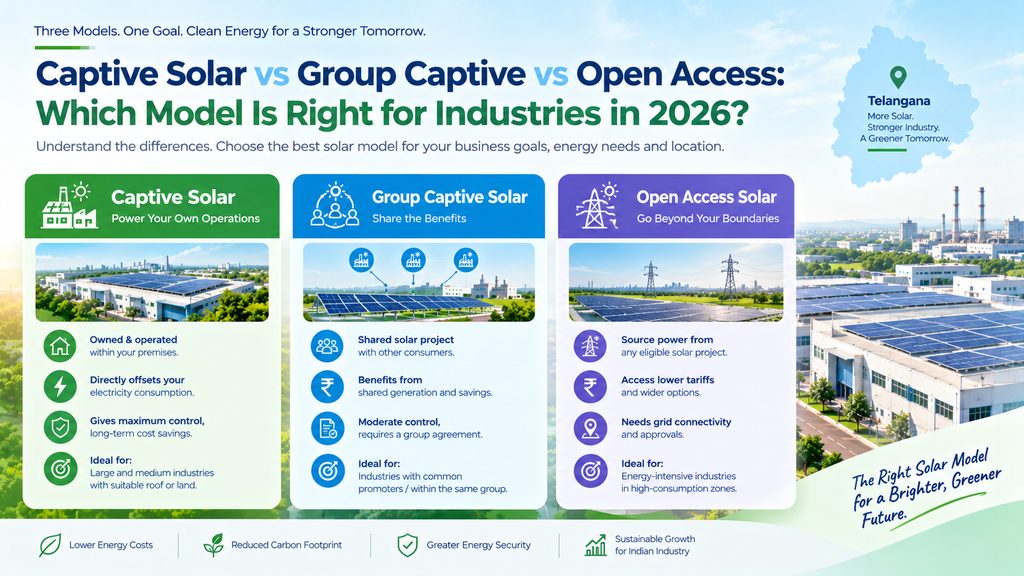
Industry – In 2026, the three models that change the bill are single captive, group captive and third party open access. All three are solar-powered. The only difference is the ownership and surcharge stack.
You can still install a rooftop slice under net metering in Telangana. That slice is small relative to a 1 MW of process load. The next decision is how to get the rest of the solar through the wire.
Quick Answer Box
If you want CSS and additional-surcharge exemption and can pass the 26 percent equity and 51 percent use tests every year, own the plant (or enough of it) If you want most of that exemption but don’t want to pay for a whole park, join a group-captive SPV. If you mean a PPA with no equity, then model CSS and sign a third-party captive power purchase agreement. Keep on-site rooftop for self-consumed units that do not have an OA stack view.
What Each Model Is
Solitary captive. You or your group companies, as now defined in the 2026 rules, own at least 26% of the generating company and use at least 51% of annual generation. The plant can sit on your land or at a remote site and wheel through open access in solar arrangements. The on-site rooftop used behind the meter is captive in the normal sense; it does not pay wheeling or CSS on units the shop consumes.
A group captive. The 26 percent is held by several industrial users, usually in an SPV, and they collectively consume 51 percent. The other 74 percent often stays with a developer. You put in equity in Crores per megawatt-share. Not the full EPC bill. You still sign some usage agreement that looks like a PPA. Status is reviewed each financial year. The 2026 amendment lets the group pass the 51 percent test together, removing the risk that one member’s shortfall would kill the plant. If a user alone owns 26 percent, they are considered something like an anchor and not subject to the same proportionate cap as a small minority holder.
Open access for third parties. The generator sells you energy. You have no equity. PPA tariff + full lawful charge stack – transmission, wheeling, losses, scheduling, banking where used, CSS and additional surcharge unless a specific exemption applies (Telangana GEOA consumers who already pay demand charges have been treated as exempt from additional surcharge under the 2024 GEOA framework, subject to the current order). This is the lowest friction contract and often the weakest landed cost in a high CSS year.
Open access is not a fourth model per se. It’s the motorway. That highway is used by captive, group captive and third party when the plant isn’t on your bus.
The Charge Stack That Decides the Spreadsheet
Self-consuming roof top units are not charged OA. Thus a 200-500 kW on-site plant is still included in almost every file.
Wheeled units are charged for wires and losses no matter the model.
CSS is the fork. Excludes qualifying units that are group or captive. Third party units are not. HT Industrial CSS of Telangana increased for FY 2026-27. Commentary published on the southern DISCOM schedule put HT-I Industry at 11 kV at around Rs.1.98 a unit, up from around Rs.1.82. Kindly check exact voltage slab on the order attached to your circle. And that’s why group captive is there, one rupee or two on every wheeled unit.
Additional surcharge is also generally out of question for captive consumption. Could still meet it with 3rd party OA unless GEOA or some other proviso.
Banking isn’t free, if you use it. or in kind deductions are applicable. Do not model 100% of generated units as nite energy.
The grid support charge in Telangana is targeted at co-located conventional or large captive plants operating in parallel and not at normal rooftop solar. Don’t assume one rooftop file will attract one. Check the existing order.
Captive solar vs group captive vs open access cost analysis
No one price. There is a rupee landed.
On-site captive rooftop, capex owned: levelised generation generally ranges between ₹2.5-3.5 a unit before financing, plus O&M. Industrial turnkey EPC still plans around ₹35,000–₹50,000 per kW in 2026. You get accelerated depreciation on the asset. You don’t get PM Surya Ghar.
Single captive off-site You fund most/all of a park. The cost of generation can be comparable to utility-scale solar. You add in wheeling and losses. You do not apply CSS and AS on captive units. This constraint is a capital.
Group captive: Equity is generally discussed around more than one crore per MW of your share depending on plant cost and 26 per cent split. Delivered power post wires without CSS is usually estimated in the range of ₹4.5-₹5.5 in friendly structures. You don’t devalue the whole park, you devalue your slice of equity.
Third-party OA, no equity. PPA headlines of ₹3–₹4.5 seem attractive till you add CSS of ₹1.5–₹2 and other charges. In 2026 C&I working papers, landed figures of ₹6–₹8 are seen. Plus ₹1.50 against Telangana HT-I energy of ₹7.65 at 11kv or ₹7.15 at 33kv Third-party OA can still save money in peak windows, ToD: It saves less than a clean captive would do.
Your RESCO on your roof is a cousin of the third party OA who has no wire charges on units self consumed. Not group captive.
Table 1: Captive vs Group Captive vs Third-Party OA
| Factor | Single captive | Group captive | Third-party OA |
| Equity | 26 percent plus, often 100 percent on-site | 26 percent collective in SPV | None |
| Use test | 51 percent of plant | 51 percent collective | None |
| CSS / AS on qualifying units | Exempt | Exempt if tests held | CSS yes; AS unless exempted |
| Wires and banking | Off-site yes; on-site self-use no | Yes | Yes |
| Typical landed band | Lowest on-site; mid off-site | Mid, often best OA rupee | Highest OA rupee |
| Capex | High | Medium | Near zero |
| AD on solar asset | Yes if you own it | On your equity | Developer’s |
| Contract | EPC or captive PPA plus OA | SHA + PPA + annual test | PPA only |
| Best fit | Roof or balance-sheet park | Cluster of HT users | Fast offtake, low CSS states |
| Main failure | Under-consumption, capex | Status loss in a bad year | Surcharge inflation |
Captive solar vs group captive vs open access pros and cons explained
Single captive advantages: tightest control, full AD if owned, no CSS on captive units, rooftop units are the cleanest electrons you will ever buy. Cons: capex, roof, 500kW net-metering lid, OA approvals if off-site, resource risk (you wear it).
Pros of Group Captives: CSS exemption at a fraction of the cost of a small park, scale better under one factory roof, 2026 rules easier on collective 51 percent. Cons: Shareholders agreement, annual audit of status, exit is slower than a PPA, equity sits on the balance sheet, you still pay wires.
Third party OA benefits: fast, no equity, easy board story. Cons: CSS in Telangana not a rounding error, tariff escalation and banking rules can eat the headline, little say if the generator under-delivers, AD stays with the owner
If a plant fails the 26/51 test for a year, it will lose the exemption for that year. Treat it as a risk, not a footnote.
Table 2: Which Model Fits Which Factory
| Situation | Start here | Usually avoid as the only route |
| Day load under 500 kW, good roof | On-site captive rooftop | Paying CSS for the same units |
| 200 kW roof, 2 MW bill | Rooftop plus group captive or OA | Pretending the roof is enough |
| Several group companies, 5 MW+ | Single captive or group with 26 percent anchor | Thin third-party in a high-CSS year |
| No capital, need units this year | Third-party OA or rooftop RESCO | Waiting for a park you will not fund |
| ESG report needs owned generation | Captive or group captive | REC-only residual |
| Load below GEOA threshold | Rooftop / DISCOM supply | Forcing an OA file |
| Peak evening kVA problem | Rooftop plus BESS, then OA for energy | OA energy as a demand-charge fix |
Green Energy Open Access in Telangana starts at 100 kW. Approvals still bottleneck large files. Rooftop net metering stays at 80 percent of industrial load and 500 kW. Combined capacity should respect contracted demand. None of the three off-site models replaces a structural roof survey.
How to Choose in One Pass
Please write last year’s HT units, contracted demand and roof kW after the four-limit test (area, 80%, 500 kW, daytime load).
If the roof kW is enough to cover most of the daytime energy then stop at captive and maintenance on-site. Add storage dedicated to ToD and demand spikes.
If the gap is big and you can write a cheque for equity. Price group captive against third party, using this year’s CSS, not last year’s brochure.
If the board will not allow holding SPV shares, price third-party OA honestly with CSS and banking, then compare that with a rooftop RESCO for the part that never leaves the premises.
Do not sign a 20 year PPA on a slide missing 1.98 Rs. Don’t buy 26 percent of a plant you cannot eat. Don’t label a third-party PPA ‘captive’ in the board note.
The right 2026 model is one where the landed rupee survives the surcharge line, and you can hang on to your legal tests for the life of the plant.
People Also Ask
What are the three types of solar systems for industry?
For procurement: single captive, group captive and third-party open access. For hardware: on-grid, hybrid and off-grid. This article is about procurement.
What is the difference between captive, group captive and open access?
Captive means you own enough of the plant and use enough of its output. Group captive shares that ownership. Open access is the grid path. Third-party OA is purchase without ownership.
Does group captive avoid all charges?
No. It typically avoids CSS and additional surcharge on qualifying captive units. Wheeling, transmission, losses and banking still apply to wheeled energy.
What is a captive power purchase agreement?
A contract to take power from a plant you have a captive stake in, or loosely a PPA labelled captive by a vendor. Read the equity clause. If there is no 26 percent stake, it is third-party OA.
What are the 26 percent and 51 percent rules?
“Captive users” must own at least 26 percent and consume at least 51 percent of the annual generation. The Electricity (Amendment) Rules 2026 retain those thresholds and treat group consumption more collectively.
Can a Telangana factory use rooftop and open access together?
Yes, within contracted load and interconnection rules. Rooftop self-use is the cheapest slice. OA covers the rest. Net metering remains 80 percent of C&I load and 500 kW.
Which model is cheapest?
On-site self-consumed captive units are usually cheapest per unit. Off-site, group captive often beats third-party OA in a high-CSS year because of the exemption. Run this year’s order, not a national average.
Who helps Telangana industries structure on-site solar next to these models?
Samraj Solar is a specialised solar EPC company, founded in 2014 by Abburi Ajay Kumar, having its head office at H.No. 3-5-242/1, Krishna Nagar, Moula Ali, Hyderabad and branch office at Guntur. The company has successfully completed projects for residential, commercial, industrial and institutional clients across Telangana and Andhra Pradesh. It is an authorised channel partner for Tata Power Solar and provides engineering, procurement and construction for industrial rooftop and hybrid plants that sit alongside open-access or captive procurement rather than replacing a lawful OA file.
Factories can put last year’s units, CMD and a roof sketch on one page. That page tells you what goes on the building, and what goes in an SPV or a PPA.