An export unit used to treat electricity as a factory overhead. The invoice went to accounts. The buyer asked about price, lead time and quality.
That split is closing. European importers now price carbon on selected goods. Brand and OEM questionnaires ask what powered the night shift that packed the container. A rooftop that only works while the sun is up no longer answers either question.
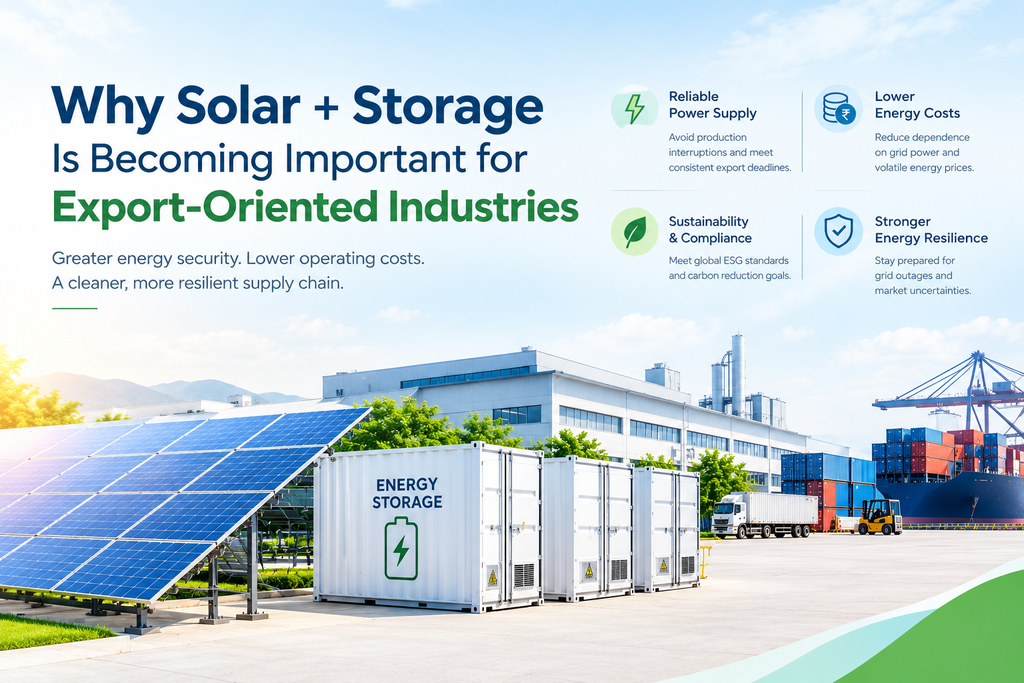
Solar storage for export oriented industries is the practical reply: generate at noon, use after sunset, keep a log.
Quick Answer Box
Add storage if you run evening or nite export lines, burn diesel when the feeder dips, pay Telangana’s ₹1.50 ToD peak or need evidence that renewable electricity was used in the production hour. The normal industrial specification is LFP two to four hour packs. Solar-only still helps the day bill. But it doesn’t time-stamp electrons for a 9 p.m. packing hall.
Why Export Plants Are Different from a Domestic Shed
Plants at home can help optimise the HT bill. Export plants optimise the bill and the file that the buyer will read.
Three pressures stack.
First, border carbon. In January 2026, the EU Carbon Border Adjustment Mechanism transitioned from reporting to a financial phase. It includes cement, iron and steel, aluminium, fertilisers, hydrogen and electricity. 2026 certificate prices have been around €75 per tonne of CO2e. India’s steel and aluminium exports account for much of the exposed value. The rules today most clearly write in indirect electricity emissions for cement and fertiliser. Metals is still a process-heavy industry. None of that allows an exporter to ignore the grid mix. Default emission factors are usually more conservative than measured plant data. Clean, time-stamped power is how you stop paying for someone else’s coal assumption.
“Secondly, buyers not waiting for Brussels. Apparel groups, pharma customers and auto OEMs have already sent scope 2 templates. Even if CBAM does not name the HS code, Hyderabad’s API and formulation plants and Telangana textile parks sell into those templates. A REC Three pressures build. show the stitching line at 8 PM in July was run on solar.
Third, the clock of production. 7 p.m. Feeder dies, export orders slip. Diesel touches the SLA at ₹18-24/unit and follows a smoke on the ESG page. Storage is not a generator plant for a two day outage. “It does cut the short dips and the evening peak that used to start the set.
This is highlighted by Telangana’s export map. Bulk-drug corridors around Hyderabad, textile capacity at parks like KMTP, food processing, granite and auto ancillaries all run second shifts. The state still limits industrial net-metered rooftop at 80 percent of sanctioned load and 500 kW. The first slice is the roof. That’s storage, and how that slice survives past 6 p.m. The rest of the annual megawatt-hours come in via open access or group captive.
What Storage Changes on an Export Line
Solar no battery exports excess at noon, often at a lower credit than at retail, and then buys grid power in the ₹1.50 ToD window. Self-consumption studies at Indian C&I sites typically show 60–65 per cent of generation being used on site without storage, rising to 85–95 per cent with a correctly sized pack.
More of the day’s generation can be attributed to the shift that actually packed the order for an exporter. The auditor can test the EMS log, not a marketing PDF.
Demand charges matter on the same invoice. Telangana HT-I Industry demand Rs 500/kVA/month. The month is set by a 15-minute evening spike. A kVA capped battery will clip that spike. If the spike is after sunset, solar alone can’t.
The third line is ToD. rebate from 10 a.m. to 6 p.m. – charge 0.50 Discharge 6pm-10pm The energy charge, adder and demand print all run on the same kw-hr.
It’s not 24/7 firm renewable power. A two hour pack is for one particular evening block. You still need the grid or diesel for a monsoon week. CFOs who export a promise of “100 percent solar operations” from a 400 kW roof and a container full of cells will fail the next questionnaire. Match promise hours and keep evidence.
Best solar storage for export oriented industries
“Best” is not a list of brands. For Indian factory heat and daily cycling it is almost always an LFP (lithium iron phosphate) system with a battery management system, a hybrid inverter or PCS and an energy management system which can show charge source and discharge window.
LFP cycles thousands of times and is more heat tolerant than NMC. Lead-acid is cheaper to buy upfront but will fail under daily peak-shave duty. Flow batteries just appear at large durations.
Nameplate not usable kWh. Ambient rating for Telangana summer plant room. Fire Detection, Clearances & CEIG Drawings. Say the pack first charges from the array and not from the ₹1.50 window.
If the solar is new, match the battery with ALMM-listed N-type TOPCon modules. Inverter path is hybrid or AC-coupled, so an old PERC roof can still feed a retrofit pack.
If the export campus is multi MW, on site storage is the timestamp tool. Off-site FDRE or solar-plus-storage PPAs volume tool Use both. Don’t confuse them.
Solar storage for export oriented industries cost
Two lines, not one line.
Rooftop solar for industrial plants still budgets around ₹35,000-₹50,000 per kW installed in 2026. So a 200 kW export-unit roof is then about ₹70 lakh-₹1 crore before odd steel.
LFP storage C&I costs installed vary widely by size. Published 2026 bands are often around ₹20,000–₹40,000 per kWh for smaller cabinets and lower per kWh as the pack moves into MWh. A 200 kWh two hour block next to a 200 kW array is typically in the range of few tens of lakhs to about a crore depending on enclosure, fire works and EMS. Judge all the public tables as one screen.
Payback four ways: avoided HT energy, avoided ToD, avoided demand rupees, avoided diesel hours. Sites with high evening peaks and regular DG use are screened in the 3–6 year band. Day-only exporters with a stiff feeder may find solar-only wins on the spreadsheet, but still should ask themselves if their buyer file needs evening matching.
No PM Surya Ghar cash on a metre of industrial export. Accelerated depreciation for owned solar and storage may apply. If the output is taxable, GST input credit may be available. MSME exporters can avail of energy lines from SIDBI and banks. Off-site volume is a separate cheque for group-captive equity.
Table 1: Export Pressure versus What Solar + Storage Does
| Pressure | Solar only | Solar + LFP storage |
| Day-shift kVAh | Strong cut | Strong cut |
| Evening packing line | Grid or diesel | Stored solar for designed hours |
| ToD ₹1.50 window | Weak after sunset | Discharge into the window |
| Demand ₹500/kVA | Only if peak is midday | EMS cap on evening spike |
| Short feeder dip | Array drops | Ride-through on backup bus |
| CBAM / buyer log | Annual RE claim | Time-stamped dispatch |
| Diesel hours | Unchanged | Cut for short events |
| 24/7 claim | Not honest | Still not 24/7 unless oversized off-site |
Blank line before continuing narrative.
Where Telangana Exporters Should Start
Map the production hour that ships. If containers leave after 6 p.m., the battery has a job even if the roof already looks full.
Pull twelve HT bills and diesel-hour logs. If ToD units and DG litres are both fat, storage has two paybacks.
Roof top constraints: Stay inside 4: usable area; 80 percent of load; 500 kW net metering; daytime kW will eat generation. Additional modules that only export cheap noon power are a weak CBAM story.
Don’t ignore process emissions work if you sell steel or aluminium. Clean electricity is good. It Get twelve HT bills and diesel hr logs. If both ToD units and DG litres are fat, storage has two paybacks.or fertiliser and cement exporters.
Reserve diesel for islanding. Add that into the sustainability note so a buyer does not think the container replaced the generator.
Table 2: Fit by Export Type
| Export type | Storage priority | Typical first pack | Watch |
| Pharma / formulation | Quality and dip ride-through | 2 hour on critical bus | Validation, clean room loads |
| Apparel / textile process | Evening lines and ToD | 2–4 hour on process + packing | Steam and dye-house peaks |
| Auto components | Shift overlap and kVA spikes | Peak-shave + solar | OEM Scope 2 templates |
| Food processing cold chain | Outage and night compressors | Longer duration on cold bus | Product loss cost |
| Steel / aluminium | Volume RE + some on-site | Small on-site, large OA/FDRE | Process emissions dominate |
| Cement / fertiliser | Electricity matching for CBAM | On-site + documented OA | Default factors vs measured |
| SEZ mixed light industry | Bill + questionnaire | Roof + 2 hour | 500 kW lid |
Solar storage for export oriented industries in india is therefore not a new gadget category. It is how an exporter turns a daytime asset into a production-hour asset and a log. The factories that treat it as CSR will buy an oversized brochure pack. The factories that treat it as a shift-matching and evidence tool will size two to four hours, keep the diesel set, and put the EMS export on the same shelf as the quality records.
People Also Ask
Why do export industries add batteries to solar?
Production and packing often continue after sunset and buyers want to know when renewable power was used. Telangana peak ToD and demand charges are in that same evening window. Storage moves solar from noon to those hours.
Does CBAM require solar plus storage?
CBAM prices had carbon included on listed goods. It doesn’t need a battery. Measured low carbon electricity, particularly where Scope 2 is in scope, reduces exposure to default grid factors Storage aids in proving timing.
What is the solar storage for export oriented industries cost?
We generally budget industrial rooftop solar at ₹35,000-₹50,000 per kW. “LFP storage for C&I scale is typically planned in the ₹20,000-₹40,000 per installed kWh range. The cost per kWh reduces with scale. Number moves with site fire and civils.
What is the best solar storage for export oriented industries?
Industrial LFP with BMS, PCS or hybrid inverter. EMS logs. Heat rating and fire file. Lead-acid. Not for everyday cycling. No residential wallbox on a 400 kW hall.
Can solar plus storage run an export plant 24/7?
Not from a capped rooftop and a two-hour pack. That combination covers a defined evening block. Full-day matching needs off-site solar or hybrid contracts plus grid or diesel residual.
Do Telangana export units get a solar subsidy?
Not PM Surya Ghar. That scheme is residential. Owned assets may claim accelerated depreciation. Large volume often sits in captive or open-access contracts.
Will a battery cut diesel on the export floor?
For short dips and evening peaks, often yes. For multi-hour blackouts, keep the generator. Write both in the buyer note.