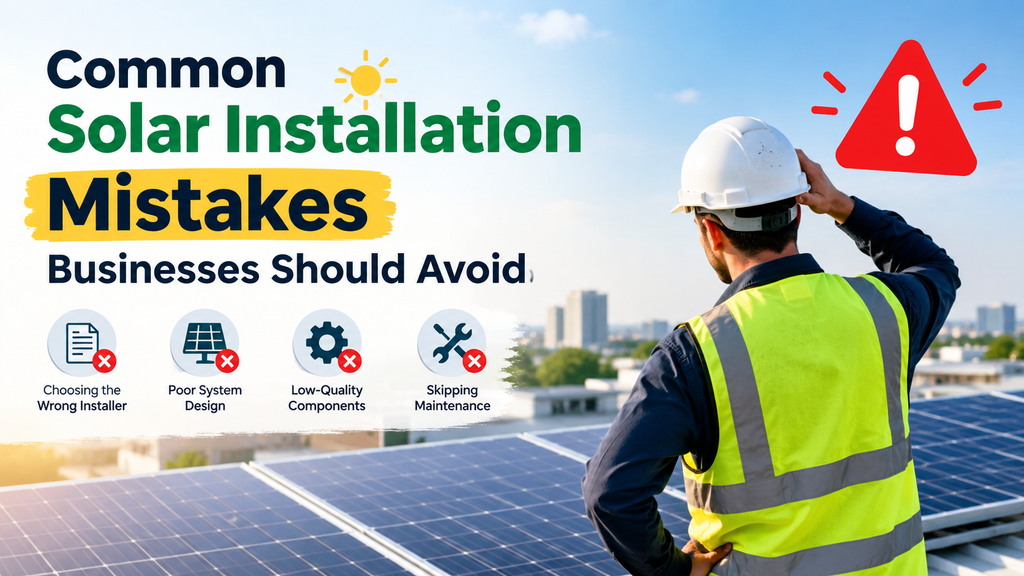
A commercial solar plant fails in slow motion, more often than on day one. The inverter turns on. The first bill is more attractive. And then year-one generation is 15–30 percent below proposal, because a water tank shadows a string every winter afternoon, the roof was never checked for load, or the cheapest bid used thin structure and mixed cables. It’s installation and design flaws, not “solar doesn’t work.”
This article is a field guide for entrepreneurs. It explains the problems that people actually look up, including the 20% and 33% rules, and the decisions that lock in losses before the first module is lifted.
Quick Answer Box
No skipping of shading analysis or structural certificate. Telangana commercial plant not to be sized beyond 80 per cent of sanctioned load under net metering (500 kW ceiling). Don’t think of the 20% rule as that ceiling. The 33% rule is oversizing of the inverter, not a subsidy. Mobilisation advance only after demanding exact module models, ALMM status, earthing design, south-facing layout where roof allows, and monitoring login.
Five Problems That Show Up After Commissioning
When owners ask what are the five most common problems with solar panels, they usually mean the whole plant, not only the glass.
The first is partial shading. If a shaded module is in a series string it can pull the whole string down. Water tanks, parapets, cooling towers, adjacent buildings and the growth of future trees are the usual sources. A noontime-only site photo missed by winter sun angles.
Second, dirt and droppings. In Hyderabad and industrial estates, unmanaged soiling reduces monthly output by 5-20 percent on a regular basis.
Third, loose or wet connections. Poorly crimped MC4 plugs, undersized cables and open trays mean heat, trips and fire risk.
Fourth is inverter problem. Units in hot rooms without airflow derate. No surge protection and weak earthing which trips everyday.
Fifth are mechanical and roof problems. Wrong tilt,light welded frames,loose clamps after two summers, drill holes unsealed leak into the floor below.
None of these are born as “bad panels.” They are born as skipped engineering.
What the 33% Rule for Solar Panels Means
The 33% rule for solar panels is a size guideline, not an order from the government. It says the total module (DC) capacity may be up to about one third larger than the inverter (AC) rating. Thus, behind about 130 kW of modules, you can put an AC inverter of 100 kW.
Designers do this because modules rarely operate at their nameplate rating in real heat, soiling and off-peak sun. A modest DC oversizing will use more of the inverter over the day. Oversizing too much cuts peak noon output, wastes modules. Too little leaves the inverter idle in the shoulder hours.
Check Allowed DC/AC ratio from inverter maker. Some units take 1.2, others 1.3 or a bit more. A quote that says “33% extra panels” but does not name the inverter model is not engineering.
What the 20% Rule for Solar Is, and What It Is Not
The most misused phrase in Indian solar sales is the 20% rule. It is not one rule
In some residential sizing notes it means to add about 20 percent headroom above calculated load so cloudy days and future appliances are accounted for. In older central subsidy tables it meant 20 percent assistance on residential capacity above 3 kW, which is not applicable in the case of commercial meters. In some states, the distribution transformer could host only a fixed percentage of rooftop capacity. WhatsApp advice that does not match Telangana copies Delhi-type examples of “20 percent of transformer capacity”. Time-of-day orders also mean peak tariffs 10-20 percent above the base.
The binding number is different for a commercial building in Telangana. The 2025 rooftop rule from TERC limits industrial and commercial net metering to 80% of the sanctioned load or contracted demand, and limits net metering to a maximum of 500 kW. You will either be forced to apply for a capacity that the DISCOM will not approve, or you will undersize the plant if someone inverts the phrase.
Ask EPC to write the rule they are using. Sanctioned load % Transformer study or DC/AC ratio If they can’t figure out where the number came from, treat it as marketing.
Design Mistakes That Cost the Most
The pricey option is to forgo a year-round shade model. At noon in May Cooling towers and lift rooms look harmless Steal winter generation Shoot for an annual shading loss of less than about 3-5 percent. Group shaded modules on separate MPPT. Don’t mix a shaded corner with a clean table on one string.
The dangerous one is skipping the structural audit. Depending on the type of structure and ballast, modules and mounts add about 12 to 25 kg/sqm. For older RCC slabs and light PEB sheets, the opinion of a chartered engineer is obtained prior to signing the contract. A plant lifted in the first monsoon is not a procurement saving.
Billing mistake is sizing to 100 percent of annual units. Solar works in the day time. A plant scaled to yearly consumption will export strongly at noon and import at nite. In a regime where export is credited below retail, that oversize is good on a brochure and weak on the ledger. Size to the 80 percent commercial cap and to daytime load.
The opposite mistake is to ignore future load. If you are planning a second production line or EV chargers, say so in the design. It’s cheaper to oversize cable trays and inverter pads a bit now than to rebuild later.
Procurement and Paperwork Mistakes
The lowest rupee-per-kW quote often excludes hot-dip galvanising thickness, cable section, surge devices and monitoring. It can also substitute for non-ALMM modules. Tougher domestic cell and module list rules for net-metering and open access projects from mid-2026. A cheap imported stack that can’t be interconnected is not cheap.
“Tier-1 panels” and other vague proposals with no model number can be replaced after signing. In the contract annexe, demand datasheets, warranty cards and the ALMM listing.
The way projects stall after the roof is full is by leaving net-metering, CEIG drawings and single-line diagrams as ‘owner’s scope.’ Unless you have an in-house electrical team that does this already. The EPC should own DISCOM feasibility, bi-directional meter coordination and statutory drawings.
Construction Mistakes on the Roof
Welded site-fabricated frames rust at the welds and are hard to inspect. Prefabricated, hot-dip galvanized members with specified coating thickness last longer on PEB roofs.
Torque is not optional.” Walk in the wind under tightened clamps. Over-tightened clamps crack frames. Follow the mount maker’s chart.
Roof penetrations without proper flashing leak. Sheet roofs: Prefer profile-matched designed clamps. Seal each drill on RCC.
Inverters need shade, airflow and service space. In May, locking a tin cabin on a west wall will cause the plant to derate each afternoon.
Cable routing in mixed AC/DC bunches, sharp tray edges and unsupported spans at mid-roof create the faults that appear two summers later.
Earthing is still treated as a rod in a flower bed. Commercial plants need designed earth pits, measured resistance and separate paths where the standard requires them. Inverter errors and unsafe fault current show up as weak earth.
Table 1: Mistake, Typical Result, What to Demand Before Signing
| Mistake | What the owner sees later | What to demand in writing |
| Noon-only shade check | 10–20 percent winter loss | Year-round 3D shade report |
| No structural certificate | Deflection, leak, insurance fight | Engineer’s load note for the actual roof |
| 100 percent annual sizing | Cheap export, high night import | Size to daytime load and 80 percent cap |
| “Tier-1” with no model | Module swap, ALMM delay | Named ALMM model and datasheet |
| Light welded structure | Corrosion, loose tables | HDG spec and prefabricated members |
| Inverter in a hot box | Daily derating and trips | Shade, airflow, clearances |
| Combined weak earthing | Trips and safety risk | Pit design and test values |
| No monitoring login | Silent string failure | Portal access from commissioning day |
Blank line before continuing narrative.
Use the table in vendor meetings. If a bidder cannot attach the documents in the right-hand column, the left-hand column is what you are buying.
Handover Mistakes That Hide for a Year
Commissioning is NOT a picture of panels. It’s Insulation tests, polarity check, inverter firmware as commissioned, a generation baseline on a clear week and a file with warranties, as-built drawings and the net-metering agreement. Without that file, the next facility manager cannot claim warranty or explain a yield drop.
No installation error in slow motion, no cleaning and inspection plan. A plant that comes in with “rain will wash it” loses money in the first dry season.
Table 2: Cheap Quote versus Engineered Commercial Install
| Item | Cheap quote pattern | Engineered pattern |
| Survey | Tape and noon photo | Shade model + structural note |
| Sizing story | Fill the roof | Load + sanctioned cap + DC/AC ratio |
| Components | Generic brands | Named ALMM modules and inverters |
| Structure | Site-welded light sections | Specified HDG prefabricated mounts |
| Electrical | Mixed cables, token earth | Sized DC/AC, tested earthing |
| Approvals | “You apply later” | EPC-led feasibility and drawings |
| Monitoring | Optional extra | Included, string or inverter level |
| Paper at handover | Invoice only | As-built pack and baseline yield |
Business owners who require the engineered column pay more on the purchase order and less on the five-year energy ledger. It is not a gap of ideology. The question is, was the plant designed for that roof and that DISCOM or was it assembled from a price list.
The first site file has the most common solar installation mistakes that you can see when you know what to open. The shade report, the structural note, the module model, the DC/AC ratio, the earthing drawing and the net-metering application. Get those six before steel hits the ceiling. Once they are in place the rest of the project is easier.
People Also Ask
What are the five most common problems with solar panels?
The top five issues you’ll see on commercial plants are: partial shading on strings, dirty glass and droppings, loose or wet connectors, inverter overheating or trips, and weak mounting or roof leaks. Rarely are the modules themselves the first to fail. The meter only sees the nameplate watts if the design, installation quality and cleaning are right.
What is the 33% rule for solar panels?
It is a DC-to-AC oversizing guideline. Module DC capacity may be about 33 percent higher than inverter AC capacity so the inverter stays useful across more of the day. Confirm the exact ratio allowed by the chosen inverter. It is not a subsidy and not a Telangana net-metering cap.
What is the 20% rule for solar?
It is used in several unrelated ways: a 20 percent sizing buffer, older residential subsidy on extra kilowatts, transformer hosting talk in some states, and ToD peak bands of about 10–20 percent. Commercial net metering in Telangana is 80 percent of sanctioned load, maximum 500 kW. Do not apply a generic 20 percent rule as your legal limit.
Why does a new plant generate less than the quotation?
Common causes are winter shading that was never modelled, soiling, a hot inverter, DC losses from thin cables, and a proposal that used optimistic units per kW. Compare a clear-week baseline with the proposal’s first-year figure and walk the roof at 9 a.m. and 4 p.m.
Can I fill the entire roof with panels?
Only if shade, structure, walkways, fire access and the sanctioned-load cap allow it. Packing extra rows that shade each other, or exceeding the 80 percent commercial limit, reduces value even if the roof looks full.
Does the cheapest EPC quote usually work out?
Sometimes the plant switches on. Yield, rust, trips and DISCOM delays then consume the saving. Compare shade reports, structure spec, named components, approval scope and monitoring, not only ₹ per watt.
What documents should exist before installation starts?
Site survey with shade analysis, structural assessment, single-line diagram, named bill of materials, DISCOM feasibility or application status, and a contract that states who owns net-metering and CEIG drawings.
Who can engineer commercial rooftop installations in Telangana without these shortcuts?
Samraj Solar, founded in 2014 by Abburi Ajay Kumar, is a specialised solar EPC company with its head office at H.No. 3-5-242/1, Krishna Nagar, Moula Ali, Hyderabad and branch office in Guntur. The company has executed projects for residential, commercial, industrial and institutional customers in Telangana and Andhra Pradesh. As an authorised channel partner for Tata Power Solar, it provides engineering, procurement, construction, documentation support and after-sales service for commercial rooftop systems.
Business owners comparing quotes can ask every bidder for the same six-page pack: shade report, structural note, named modules and inverters, DC/AC ratio, earthing sketch and net-metering responsibility. The pack sorts engineering from price-only offers quicker than a second meeting.